There have been moments in the therapy room that have stayed with me long after the session ends.
- A capable, self-aware woman who has read the books, listened to the podcasts, understands her patterns deeply—and still finds herself lying awake at night wondering, “Why can’t I actually follow through on the things I know would help me?”
- A loving parent who has spent hours researching ADHD, anxiety, emotional regulation, and parenting strategies… yet still finds herself snapping, shutting down, or feeling completely flooded in the middle of her child’s hard moments—and then carrying guilt about it afterward.
- An adult who can explain exactly why they react the way they do, has strong insight and emotional awareness, and may even function well professionally—yet privately feels frustrated that insight alone hasn’t created lasting change in their daily life, relationships, or nervous system responses.
These are not rare situations.
In fact, they are some of the most honest and important moments I have eperienced with clients in therapy.
And over time, those moments led me to ask a different kind of question:
What if the barrier isn’t insight… but capacity?
Why I Began Exploring Something More
After more than 30 years in practice, I have a deep respect for therapy.
I have seen it change lives.
But I have also seen that therapy asks a lot of the brain.
It asks the brain to:
- regulate emotion
- tolerate discomfort
- shift patterns
- stay engaged
- translate insight into action
And sometimes, even when someone is fully invested in the process, those systems are under strain.
When that happens, therapy can still be helpful—but it can feel:
- harder than expected
- slower than hoped
- difficult to carry into daily life
This is what led me to begin researching brain-based approaches more seriously—not as a replacement for therapy, but as a way to:
Support the conditions that make therapy work.
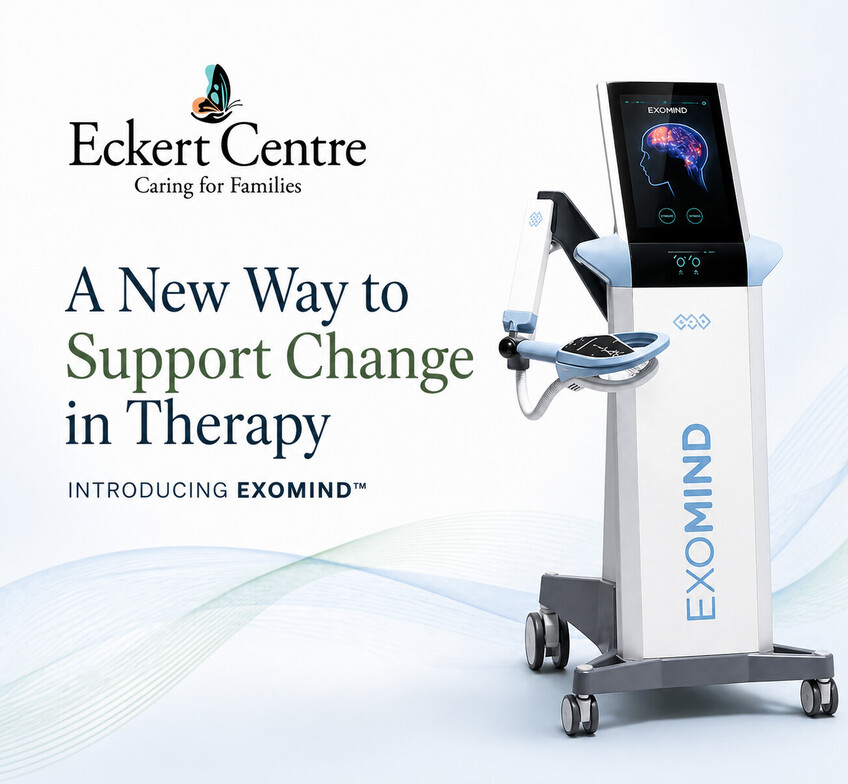
That exploration is what eventually led to ExoMind™.
What Is ExoMind™—and Why It Matters Here
ExoMind™ is a non-invasive, brain-based therapy that uses repetitive transcranial magnetic stimulation (rTMS) to support areas of the brain involved in mood, regulation, and cognitive flexibility.
While rTMS has been used in hospital settings for decades, recent advancements in 2025 have made the experience more comfortable and accessible—opening the door for neuromodulation to move into community-based clinics like ours.
At Eckert Centre, ExoMind™ is:
- Integrated into psychological care (not separate from it)
- Guided by a psychologist-led intake and follow-up
- Aligned with your therapy goals and overall well-being
Learn more about how ExoMind™ supports specific concerns:
This was a very intentional decision.
Because this is not about offering a “new treatment.”
It is about offering a more complete way to support change.
Not Just for When Therapy Feels Stuck
Sometimes clients come to us feeling stuck—and this approach can help.
But just as often, clients are:
- starting therapy and wanting strong momentum
- making progress and wanting to deepen it
- understanding their patterns, but struggling with follow-through
- feeling mentally or emotionally taxed in ways that make change harder
Others may not have a formal diagnosis, but recognize patterns such as:
- persistent overthinking
- low motivation or disconnection
- difficulty with focus or organization
- challenges shifting habits
- emotional reactivity or shutdown
- feeling “not quite like themselves”
Explore additional areas where ExoMind™ may help:
- Brain Health and Cognitive Function
- Menopause and Postpartum Support
- ADHD, Focus, and Follow-Through
- Habits, Cravings, and Behaviour Change
These experiences matter—and they deserve thoughtful options.
How This Fits Within the Eckert Centre Well-Being Model™
At Eckert Centre, our work is guided by the Eckert Centre Well-Being Model™, which considers the whole person within the context of their life.
This includes:
- Intrapersonal functioning (brain capcity, nervous system, internal experiences - thoughts, emotions, and sensations)
- Interpersonal relationships (connection, communication, attachment)
- Family system stability (parenting, routines, home, work, and school environments)
- Meaning-making (identity, values, purpose, worldview)
ExoMind™ supports the intrapersonal wing—the brain and nervous system capacity that underlies everything else.
When this layer is supported, clients often find:
- emotional regulation becomes more accessible
- therapy feels easier to engage in
- change becomes more consistent over time
This is not about bypassing therapy.
It is about helping therapy work more fully.
A Careful and Transparent Approach to Evidence
ExoMind™ is:
- Health Canada–approved for depression, anxiety (including OCD), and binge eating
- supported by a strong and growing body of research
There are also emerging areas of research, including:
- trauma-related symptoms
- cognitive functioning in aging, postpartum, and menopause
- habit and behavioural patterns
- executive functioning symptoms in ADHD
At Eckert Centre, we use a tiered evidence framework:
- Tier 1 (Established): Strong research and regulatory approval
- Tier 2–3 (Emerging): Growing evidence, used with clinical judgment
- Tier 4 (Exploratory): Early-stage understanding, approached cautiously
We support informed decision-making by our clients, ensuring thoughtful, individualized care.
Why This Matters to Me — Thirty Years Later
At this stage in my career, I am not looking to add more for the sake of growth.
If anything, I feel a deeper responsibility to be selective.
What continues to guide me is this:
People are not only looking for fewer symptoms.
They are looking for a better life.
They want to feel:
- more like themselves
- more present in their relationships
- more able to engage in daily life
They are moving toward well-being—and ultimately, flourishing.
Bringing ExoMind™ into Eckert Centre was a thoughtful decision to support that process more fully.
Offering More Choice—Within a Trusted Model of Care
This reflects something we value deeply:
More choice in how you care for your mental health—within a trusted, integrated model.
For some, therapy alone is enough.
For others, integrating ExoMind™ may make the process:
- more effective
- more accessible
- more sustainable
Moving Forward
If you are wondering whether ExoMind™ could be a helpful addition to your care, we offer a brief consultation to explore fit.
Together, we consider:
- your goals
- your current experience
- and whether this approach aligns with your needs
The goal is not to add more—but to ensure what we offer truly supports meaningful change.
Book Free 15-Minute Consultation Here
About the Author
Kimberly Eckert, M.A., R.Psych.
Executive Director, Eckert Centre
Kimberly Eckert is a Registered Psychologist with over 30 years of experience supporting individuals and families through meaningful life challenges. As the founder and Executive Director of Eckert Centre, she has spent her career developing a model of care that looks beyond symptoms to support the whole person.
Her work is grounded in the Eckert Centre Well-Being Model™ (intrapersonal, interpersonal, family system, and meaning-making)—a framework that reflects her belief that lasting change happens within the context of relationships, daily life, and a person’s sense of meaning and identity.
Kimberly remains deeply committed to thoughtful, ethical care. Her decision to introduce ExoMind™ comes from years of observing where clients continue to struggle—and a desire to offer more complete, evidence-informed ways to support healing and growth.