Bladder Control & Sexual Wellness
Confidence to Participate Fully in Your Life
When your pelvic floor changes, it can begin influencing far more than bladder control. Changes after childbirth, menopause, prostate treatment, or trauma are common for both women and men.
You may be experiencing:
- Bladder leakage
- Urinary urgency and frequency
- Pelvic floor weakness
- Reduced confidence with movement or exercise
- Somatic guarding and chronic muscle tension
- Changes in intimacy and sexual wellness
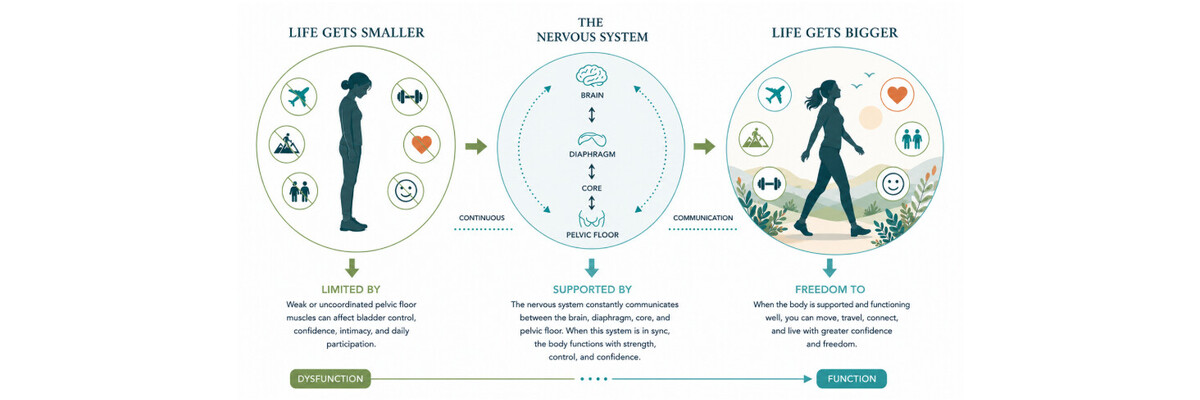
Over time, many people begin adapting their lives around these changes. They stop running, travelling, exercising, laughing freely, or saying yes to opportunities they once enjoyed.
Life becomes smaller.
Although these changes often begin in the body, their impact is rarely limited to physical symptoms. They can influence confidence, independence, relationships, emotional well-being, and ultimately the freedom to participate fully in everyday life.
Many people assume this is simply part of getting older, having children, menopause, or prostate surgery.
The good news is that today's science tells us a different story.
Why Psychology Belongs in This Conversation
At first glance, pelvic floor therapy may seem like an unusual service to find in a psychology practice.
For us, it is a natural extension of how we have understood human well-being for more than thirty years.
As psychologists, our work has never been limited to reducing symptoms. Our goal has always been to help people participate more fully in their lives. Over the years, we have watched people gradually stop doing the things they love—not because they lacked motivation, but because their brain and body were working harder than they needed to.
Today, neuroscience helps us understand why.
The brain and nervous system are in continuous communication with the diaphragm, core, and pelvic floor. Together, these systems coordinate breathing, posture, movement, continence, emotional regulation, and many of the physical functions that allow us to move confidently through daily life.
When this communication becomes less efficient—whether through childbirth, menopause, aging, surgery, chronic stress, persistent muscle guarding, or illness—the effects are often felt far beyond the pelvic floor. Confidence changes. Movement changes. Relationships change. Participation changes.
This is why we offer Emsella™ as part of our Brain & Body Therapies Program.
We see it as one way of supporting the nervous system's ability to coordinate the pelvic floor more effectively, helping people regain the confidence and capacity to participate more fully in everyday life.
For us, stronger pelvic floor muscles are not the destination.
They are one step toward something much more meaningful:
Helping life become bigger again.
.jpg)
What Is Emsella™?
Emsella™ is a non-invasive treatment for women and men that uses High-Intensity Focused Electromagnetic (HIFEM®) technology to stimulate thousands of deep pelvic floor muscle contractions during each session.
Unlike traditional pelvic floor exercises, which rely on your ability to voluntarily contract the correct muscles, Emsella helps activate muscles that may have become weakened, difficult to recruit, or poorly coordinated over time.
Each treatment is completed while you remain fully clothed and comfortably seated in the Emsella chair. Sessions take approximately 30 minutes and require no recovery time, allowing you to return to your normal daily activities immediately afterward.
At Eckert Centre, we view Emsella as one evidence-informed way of supporting the nervous system's ability to coordinate the pelvic floor more effectively. Stronger, better-coordinated pelvic floor muscles can contribute to improved bladder control, confidence, movement, intimacy, and ultimately a greater capacity to participate fully in everyday life.
What To Expect



Think of Your Pelvic Floor Like a Supportive Hammock


Your pelvic floor is a group of muscles that stretches across the bottom of your pelvis like a supportive hammock. These muscles help support the bladder, bowel, reproductive organs, and core while also contributing to bladder control, posture, breathing, movement, and sexual function.
Throughout life, this hammock can gradually lose strength or coordination. Childbirth, menopause, prostate treatment, aging, surgery, chronic stress, persistent muscle guarding, and everyday wear can all influence how effectively these muscles work together.
When the pelvic floor becomes weaker or more difficult for the nervous system to activate, the hammock begins to lose its support. Bladder leakage, urgency, reduced confidence, changes in intimacy, and pelvic floor dysfunction can begin affecting everyday life.
Traditional pelvic floor exercises can be helpful, but only if the correct muscles are being activated consistently and with enough intensity. Many people unknowingly struggle to recruit these muscles effectively, even with the best intentions.
Emsella™ approaches this challenge differently. Using High-Intensity Focused Electromagnetic (HIFEM®) technology, it stimulates thousands of deep pelvic floor muscle contractions during every treatment session. Rather than asking you to "try harder," the technology helps activate and strengthen muscles that may have become difficult to recruit on your own.
You can think of it as giving your pelvic floor a highly targeted workout while helping the nervous system improve the coordination of the muscles that support bladder control, movement, and everyday function.
Backed by Clinical Research
Emsella™ is supported by a growing body of clinical research demonstrating improvements in bladder control, quality of life, and sexual wellness for both women and men.
While every individual responds differently, published studies have consistently shown meaningful improvements in urinary incontinence symptoms, pelvic floor function, and patient-reported quality of life following a course of Emsella treatments.
At Eckert Centre, we believe people deserve treatments that are supported by evidence. That's why we carefully evaluate the research before introducing any new Brain & Body Therapy into our practice.
The following research highlights summarize some of the clinical outcomes reported in published Emsella studies.
Clinical Research: Bladder Health
Clinical studies have shown meaningful improvement across multiple measures after a course of Emsella treatments.
These findings are important because improving bladder control isn't simply about reducing symptoms.
It's about helping people return to the activities they may have gradually stopped doing.
It's about quality of life.
It;s about restoring confidence.
It's about making life bigger again.
Clinical Research: Sexual Health for Women
Research has also explored Emsella’s role in sexual health for both women and men.
For women, studies have reported improvements in sexual satisfaction, desire, arousal, orgasm frequency, and intimate relationships.
Clinical Research: Sexual Health for Men
Research has also explored Emsella’s role in sexual health for both women and men.
For men, studies have reported improvements in erectile function measures and sexual satisfaction following Emsella treatments.
What Could Become Possible?
Every person's journey is different, and no treatment can guarantee specific outcomes. However, one of the most meaningful conversations we have with clients isn't about muscles or technology—it's about what they hope to get back.
For some, it is sleeping through the night without repeatedly waking to use the washroom. For others, it is returning to exercise, travelling with confidence, laughing freely without worrying about leakage, or feeling more relaxed and connected during intimacy. Sometimes it is simply the relief of no longer organizing daily life around the location of the nearest washroom.
At Eckert Centre, we measure success by more than symptom reduction. We look at whether people are able to participate more fully in the activities, relationships, and experiences that matter most to them. Because stronger pelvic floor muscles are not the final goal.
Living a bigger life is.
Your Next Step
Choosing a new treatment shouldn't feel overwhelming, and you don't have to decide whether Emsella™ is right for you on your own.
Your first step is simply a consultation with Lauren Kaiser, our Brain & Body Therapies Care Coordinator. Lauren will take time to understand your concerns, answer your questions, explain how Emsella works, review whether it may be an appropriate option for your needs, and guide you through what to expect if you decide to move forward.
If Emsella isn't the right fit, we'll discuss other options that may better support your goals. Our priority is helping you find the approach that best restores your capacity to participate fully in everyday life.
Lauren Kaiser
Brain & Body Therapies Care Coordinator
📧 Email: info@eckert-psychology.com
📞 Phone: (403) 230-2959
Frequently Asked Questions
Emsella™ is a non-invasive treatment that uses High-Intensity Focused Electromagnetic (HIFEM®) technology to stimulate thousands of deep pelvic floor muscle contractions during each session. These contractions help strengthen and retrain the pelvic floor muscles that support bladder control, pelvic stability, and sexual wellness.
Emsella may be appropriate for women and men experiencing:
- Bladder leakage
- Urinary urgency or frequency
- Pelvic floor weakness
- Changes following childbirth
- Menopause-related pelvic floor changes
- Recovery following certain prostate procedures
- Reduced confidence during exercise or daily activities
- Sexual wellness concerns related to pelvic floor function
Your consultation helps determine whether Emsella is appropriate for your individual needs.
Kegel exercises rely on your ability to correctly identify and activate your pelvic floor muscles. Many people unintentionally contract the wrong muscles or are unable to generate enough intensity for meaningful strengthening.
Emsella bypasses this challenge by using HIFEM® technology to stimulate thousands of powerful pelvic floor contractions during a single session—far more than most people could achieve voluntarily. It helps retrain the neuromuscular connection between the nervous system and pelvic floor.
No.
Most people describe feeling rhythmic pelvic floor contractions or a tingling sensation as the muscles work. Treatment intensity is gradually adjusted based on your comfort level.
There is no surgery, no needles, and no anaesthetic required.
No.
You remain fully clothed throughout your treatment. Simply wear comfortable clothing without large metal objects such as heavy belt buckles or metal accessories.
Each treatment lasts approximately 30 minutes, making it easy to fit into your workday or other daily activities.
No.
You can return immediately to work, exercise, driving, or your usual daily routine following treatment.
Your treatment plan is individualized.
Many clinical protocols involve an initial series of six treatments over three weeks, followed by maintenance sessions when appropriate. During your consultation, we'll recommend a plan based on your symptoms, goals, and health history.
Some individuals notice changes during the first few treatments, while others experience more gradual improvement over the following weeks as the pelvic floor continues to strengthen.
Results vary depending on the individual and the nature of the pelvic floor dysfunction.
Research suggests improvements can be maintained with appropriate follow-up care.
Many individuals benefit from periodic maintenance treatments, particularly if they have ongoing factors affecting pelvic floor function such as aging, menopause, or chronic pelvic floor weakness.
No.
Although Emsella is well known for improving urinary incontinence, pelvic floor muscles contribute to many aspects of health, including pelvic stability, posture, sexual function, confidence with movement, and participation in everyday activities.
At Eckert Centre, we view Emsella as supporting overall pelvic floor function—not simply treating bladder symptoms for the purpose of improving your overall quality of life.
Clinical research has reported improvements in several aspects of sexual wellness for both women and men, including sexual satisfaction and function.
Because sexual function is influenced by many physical, hormonal, neurological, psychological, and relationship factors, individual outcomes will vary.
At Eckert Centre, we believe the brain, nervous system, diaphragm, core, and pelvic floor function as an integrated system. When communication within that system is disrupted, people often experience changes that extend far beyond bladder control—including confidence, movement, intimacy, sleep, emotional well-being, and participation in everyday life.
We don't simply ask how to strengthen the pelvic floor.
We ask how to restore a person's capacity to participate more fully in life.
That whole-person perspective is why Emsella is part of our Brain & Body Therapies Program.
Emsella is a non-invasive medical device with a well-established safety profile when used appropriately. Before treatment, we complete a consultation to review your health history and determine whether Emsella is suitable for you.
Certain implanted electronic devices or metal implants may make treatment inappropriate, which is why screening is an important first step. We also will advise you if we need your family doctor to review your plan for Emsella before starting.
The best place to start is with an initial intake.
We'll take time to understand your symptoms, health history, goals, and any factors that may be contributing to your concerns. If Emsella is appropriate, we'll recommend a personalized treatment plan. If another approach is likely to better meet your needs, we'll discuss those options with you as well.
Yes. The pelvic floor is part of an integrated system that works closely with the diaphragm, core muscles, and nervous system. When this system functions well, it supports movement, breathing, bladder control, and participation in everyday life. While Emsella is designed to strengthen the pelvic floor, many people find that improvements in physical function also increase confidence and make it easier to re-engage in activities they had begun avoiding.
Because stronger pelvic floor muscles are not the goal—they're the means to the goal.
Our goal is to help people return to exercising without worry, travel with greater confidence, sleep more comfortably, enjoy intimacy, laugh freely, and participate more fully in the life they want to live.
That philosophy is what makes Eckert Centre different.
Yes. Eckert Centre offers direct billing for Emsella™, depending on your insurance provider and individual plan. If direct billing is unavailable, we provide same-day emailed receipts that you can submit to your insurer for reimbursement, subject to your coverage.
Financing is also available through Beautifi, allowing you to spread the cost of treatment over monthly payments. Visit our Financing page to learn more and apply.
