
September often begins with good intentions.
Parents spend August buying school supplies, organizing schedules, and trying to establish routines that will make the school year run more smoothly. By the second or third week, many families find themselves slipping into a familiar pattern of reminders, negotiations, and conflict.
Homework isn't getting started. Mornings feel rushed. Your teenager seems irritable or withdrawn. Every conversation about school, sleep, or responsibilities seems to end in frustration.
It's easy to conclude that your teen needs to try harder or become more responsible.
Sometimes they do.
But many parents are surprised to discover that what looks like defiance or lack of motivation is often a nervous system that is overwhelmed by the demands of returning to school.
Adolescence is a period of enormous neurological, emotional, and social development. Add academic pressure, extracurricular commitments, changing friendships, increasing independence, and the uncertainty that comes with discovering who they are, and September can become one of the most demanding times of the year.
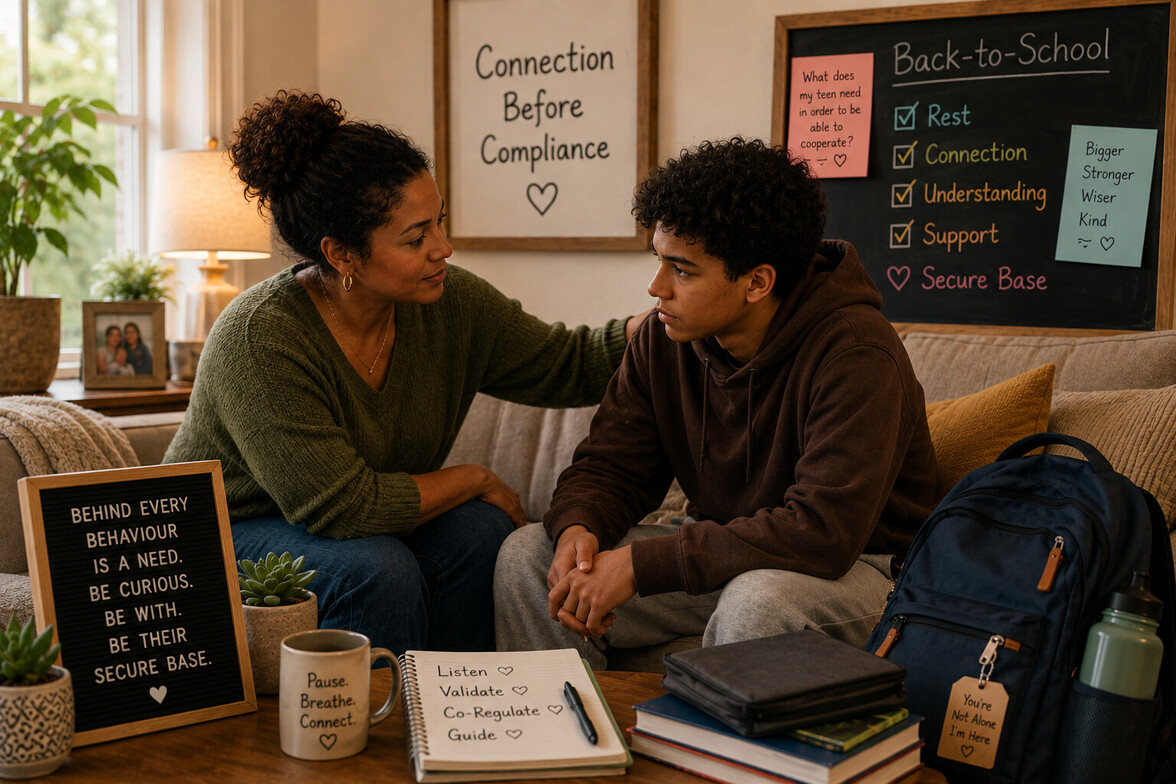
Before we ask, "How do I get my teen to cooperate?" it can be helpful to ask a different question:
What does my teenager need in order to be able to cooperate?
That shift in perspective is at the heart of attachment-informed parenting.
One of the principles I return to most often with families is this:
Your teenager's nervous system needs connection before it can consistently access cooperation.
This doesn't mean expectations disappear. Teenagers benefit from structure, healthy limits, and parents who are willing to lead. However, our ability to guide them is strengthened—not weakened—when the relationship feels emotionally safe. Connection is not permissiveness. It is the foundation that allows guidance, teaching, and accountability to be received. It’s checking in with your teen to see if there are unmet needs, or perhaps nervous system activation or shutdown getting in the way of their well-being.
Back-to-School Is More Than a Schedule Change
Parents often notice changes in behaviour during the first several weeks of school without recognizing how much adjustment is happening beneath the surface.
In a typical school day, a teenager may spend six or seven hours navigating social expectations, managing academic demands, moving between classes, interpreting peer relationships, and adapting to constant sensory input. Many are also trying to figure out where they belong, how they are perceived by others, and whether they measure up.
For neurodivergent teens, the effort can be even greater. Some spend much of the school day masking differences, suppressing stims, monitoring their behaviour, or working much harder than their peers to manage executive functioning demands. By the time they arrive home, they may have very little capacity left.
Parents usually see the end of that process (like exhaustion or irritability) rather than everything that came before it.
A teenager who disappears into their bedroom after school may not be avoiding the family. They may be trying to recover from hours of sustained social and cognitive effort.
A teenager who procrastinates for hours before beginning homework may not be choosing laziness. Their brain may be struggling to shift from one demanding task to another after a day of constant mental effort.
Understanding the nervous system doesn't excuse unhealthy behaviour, but it does help us respond more accurately. When we understand what is driving behaviour, we're more likely to choose interventions that actually help.
Looking Beneath the Behaviour
One of the most helpful ideas from the Circle of Security model is that behaviour is communication. Rather than focusing only on stopping a behaviour, parents are encouraged to become curious about the need underneath it.
This can be difficult during stressful moments because behaviour naturally captures our attention. Sarcasm, withdrawal, irritability, or refusing to engage all invite us to react quickly. Slowing down long enough to become curious changes the conversation.
Imagine your fifteen-year-old comes home from school and responds to every question with a sharp tone. A compliance-first approach might immediately address respect and attitude. Those expectations still matter, but curiosity asks another question before moving into correction.
What happened today?
Was there conflict with friends? A disappointing grade? A presentation that felt overwhelming? Did they spend the day trying to hold themselves together?
Parents don't always need the answers to those questions. Simply approaching a teenager with genuine curiosity communicates that we believe there is a reason for what we are seeing, even if we don't yet understand it.
When teenagers experience that kind of curiosity consistently, they are often more willing to let parents into their internal world.
Bigger, Stronger, Wiser, and Kind
One of the most memorable ideas in Circle of Security model is that caregivers are invited to be Bigger, Stronger, Wiser, and Kind.
I appreciate this framework because it captures the balance that so many parents are trying to achieve during the teenage years.
Being bigger does not mean becoming intimidating or controlling. It means remembering that we are the adult in the relationship, especially when emotions are running high.
Being stronger is not about winning arguments. It is the ability to stay emotionally steady when our teenager is struggling. A regulated parent provides stability that an overwhelmed nervous system can borrow.
Being wiser means looking beyond the immediate conflict and asking what developmental need sits underneath it. Is this really about homework, or is your teenager carrying anxiety about falling behind? Is this argument about curfew, or is it part of the normal developmental work of becoming more independent?
Kindness holds all of that together. Teenagers are much more likely to receive correction when they know that the relationship is secure. Kindness does not remove expectations or consequences. It communicates that accountability exists within a relationship, not instead of one.
The Circle of Security also reminds caregivers to follow the child's need whenever possible and take charge whenever necessary.
For parents of teenagers, this often means holding two truths at the same time. Your teen may genuinely need empathy after a difficult day, and they may still need to complete their homework. They may need you to understand why they snapped at you, and they may still need to repair the way they spoke.
Connection and accountability are not competing values.
Being With Instead of Fixing
As parents, our instinct is often to make things better. When our teenager comes home discouraged, anxious, or angry, we naturally reach for solutions:
"Maybe you should just ignore them."
"You need to be more organized."
"It'll be okay."
"Just focus on the positive."
While these responses are well-intentioned, they often skip over something teenagers need before they are ready to receive advice. The Circle of Security calls this "being with." Rather than trying to stop or solve a feeling, we learn to stay present with it. We communicate, "You don't have to carry this alone." For many teens, this is surprisingly rare.
They spend much of their day performing, achieving, comparing, and problem-solving. Home can become the one place where they don't need another coach—they need a compassionate companion. Being with doesn't mean dwelling in difficult emotions. It means making space for them.
Imagine your Grade 10 student comes home and says, "I bombed my math test." A fixing response might sound like: "Well, you'll do better next time. Maybe you just need to study more."
A "being with" response sounds different: "That really hurts. You worked hard for that test."
Or, "Do you want me to listen, help you problem-solve, or just sit with you for a minute?"
You don’t need to solve anything for your teen to no longer feel alone in their experience. When we feel less alone, we feel more safe. And safety changes brains.
Co-Regulation Comes Before Self-Regulation
One of the most important truths in attachment research is that emotional regulation develops first in relationship. Before young people can consistently regulate themselves, they repeatedly experience another regulated nervous system helping them organize overwhelming emotions. The Circle of Security describes this as caregivers helping organize a child's feelings through repeated experiences of "being with." This remains true during adolescence.
Although teens are developing greater independence, their brains are still under construction. The regions responsible for planning, impulse control, perspective taking, and emotional regulation continue developing well into young adulthood.
That means there will be moments when your non-anxious presence becomes more important than your words. When parents become dysregulated alongside their teen, both nervous systems begin reacting instead of relating. When parents remain grounded, they lend their nervous system to their teenager until the storm begins to settle.
Think about the after-school hours. Your teen walks through the door, tosses their backpack onto the floor, answers every question with one-word responses, and disappears into their room. Many parents immediately move toward correction.
"You haven't even said hello."
"You need to start your homework."
"Don't disappear on me."
Instead, consider what connection before compliance might sound like.
"Welcome home."
"I'm glad you're here."
"Looks like today took a lot out of you."
"I'll be downstairs whenever you're ready."
You haven't removed expectations. Homework and responsibilities still matter. But now you have started with a balm for their activated nervous system: "You are safe here." Teenagers often become more available for conversation after they've had an opportunity to decompress with someone who isn't demanding immediate performance.
Four Questions to Ask Before Correcting
As September routines begin, consider pausing before moving immediately toward compliance. Ask yourself:
What might my teen's nervous system be communicating right now?
Do they need direction, or do they first need to feel understood?
Can I stay Bigger, Stronger, Wiser, and Kind in this moment?
Am I trying to change behaviour, or strengthen the relationship that makes change possible?
These questions don't slow parenting down. They make it wiser.
The Goal Isn't Perfect Parenting
If reading this leaves you thinking, "I don't always respond this way," you're in good company. None of us do. We all lose patience and have moments when stress speaks louder than wisdom.
The Circle of Security was never designed to create perfect parents. Instead, it invites caregivers to become increasingly aware of what their teen needs and to keep returning to the relationship. Even when we miss the moment, we can come back to it. It's learning to recognize when our own stress, fear, or urgency is driving the interaction instead of our teen's actual needs. It is noticing those moments with compassion, taking a breath, and choosing to reconnect. That choice, repeated over hundreds of ordinary interactions, helps create the kind of relationship that teenagers carry with them long after they leave home.
This School Year, Choose Connection First
As backpacks fill and calendars become crowded once again, it's easy to believe that success depends on getting teenagers to do more. More homework. More responsibility. More organization. More effort.
But before teenagers can consistently cooperate, they need to experience something even more foundational. They need to know there is an adult who sees beyond their behaviour, who is Bigger, Stronger, Wiser, and Kind. An adult who can stay with them when life feels overwhelming. An adult who understands that connection is not the reward for good behaviour—it is the foundation from which healthy behaviour grows.
This September, perhaps the most important question isn't, "How do I get my teen to listen?" Instead, try asking, "How can I become a secure base from which my teen can face this school year?"
Connection before compliance is not a parenting technique. It is an attachment-informed way of relating that recognizes a simple truth: teenagers are better able to learn, cooperate, and grow when their nervous systems experience home as a secure base rather than another place where they have to perform.
Need Support Navigating the Teen Years?
The transition back to school can magnify anxiety, emotional overwhelm, executive functioning challenges, family conflict, and the everyday stress of adolescence. Parents don't have to navigate those changes alone.
At Eckert Psychology & Education Centre, our psychologists and counsellors work with teens and their families to strengthen emotional regulation, build resilience, and deepen the parent-teen relationship. Whether your teen is struggling with anxiety, school avoidance, neurodivergent burnout, identity development, or the pressures of growing up, we're here to help your family move beyond survival and toward lasting connection.
Ready to take the first step?
Book a consultation or your first session directly online.
Our Eckert Centre team of trauma-informed psychologists and counsellors in Calgary offers:
- Family Counselling
- Teen Counselling
- Parent Support Counselling
- Individual Therapy
- Neurodiversity Affirming Therapy
- Beyond Scores™ Psychoeducational Assessments
We offer 30 minute consultations and in-person counselling sessions in Calgary, as well as secure online therapy anywhere in Alberta, including Airdrie, Cochrane, and Okotoks. (403) 230-2959 | info@eckert-psychology.com | Book Online
Reference
Circle of Security International. www.circleofsecurityinternational.com
About the Author
Jess Dell Andrews is a Registered Psychotherapist (CRPO)and a Canadian Certified Counsellor (CCC) with a Master's degree in Psychotherapy & Spiritual Care. She works with adults and teens (ages 13+) at Eckert Psychology & Education Centre in Calgary, AB.
Jess brings a background as a Registered Nurse into her clinical work, offering a holistic understanding of how emotional, relational, physical, and life-context factors shape the way we move through the world. Her approach is relational and trauma-informed, drawing on Internal Family Systems (IFS), nervous system-informed therapy, CBT, somatic and mindfulness-based techniques, and faith-based counselling. Every session is paced to your nervous system and shaped by your unique ways of making meaning.
She loves working with teens and parents together or in combination with individual therapy.
You can book directly at eckertpsychology.janeapp.com.




Frequently Asked Questions
Start by recognizing that back-to-school adjustment involves more than schedules and routines. Your teen may be managing increased academic demands, social pressure, sensory input, and anxiety. Connection, predictable routines, opportunities to decompress, and support with emotional regulation can help their nervous system adjust before adding more demands.
Connection before compliance means helping your teen feel understood and emotionally supported before expecting them to cooperate with a request or solve a problem. This does not mean removing boundaries or allowing inappropriate behaviour. In the Circle of Security approach, parents remain Bigger, Stronger, Wiser, and Kind, balancing emotional connection with appropriate leadership and limits.
Teenagers continue to develop their ability to regulate emotions, and supportive relationships remain important during adolescence. Through repeated experiences of a calm, emotionally available adult being with them during difficult emotions, teens can gradually develop stronger internal regulation skills. The Circle of Security model describes this process as helping children organize their feelings through co-regulation and “being with.”
Consider what demands your teen may have been managing throughout the school day, including executive functioning, sensory demands, social expectations, anxiety, or masking. Providing time to decompress and reconnect before immediately addressing homework or responsibilities can help reduce overwhelm. Connection does not eliminate expectations; it can make it easier for a teenager to access the regulation and cooperation needed to meet them
No. Connection is not permissiveness. A connection-based approach allows parents to acknowledge and be with a teenager's emotions while still maintaining appropriate boundaries, expectations, and accountability. Circle of Security describes the caregiver's role as being Bigger, Stronger, Wiser, and Kind, following the young person's needs when possible and taking charge when necessary.
