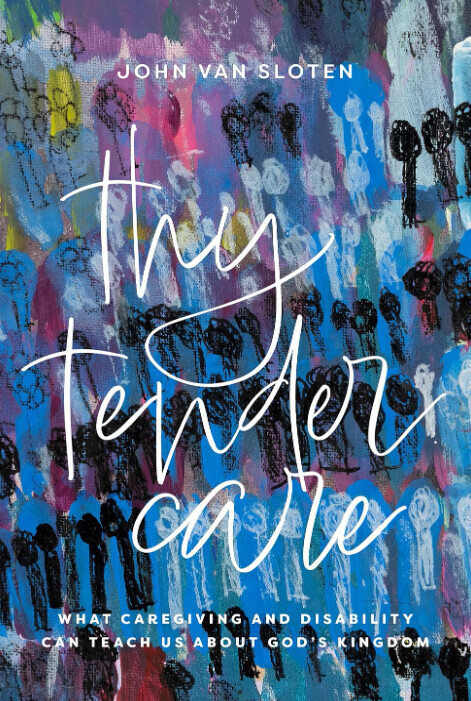
John Van Sloten’s Thy Tender Care: What Caregiving and Disability Can Teach Us About God’s Kingdom is a book I did not read as a stranger, first meeting John and his son Edward on the pages of this book. Instead, I met Edward when he was a boy. I was beginning my career as a provisional psychologist, and my supervisor arranged for me to spend time at Calgary’s PREP Program. I had no plan to specialize in working with people with Down syndrome. Yet those hours changed the direction of my career. Over time, I developed a clinical specialty in supporting children with Down syndrome who grew into teenagers and then adults, and the families who supported and lived alongside them. It has been extraordinary work, and work for which I remain deeply grateful. That is when I also met Edward and his parents, John and Fran. I also later knew John from a pew, as my pastor, and knew Edward as part of our community. So I cannot read John’s Thy Tender Care as someone encountering this family for the first time. I read it as a psychologist, a mother, a person of faith, and someone who has been blessed by knowing them.
John’s honesty on the first pages of his latest book undid me. He describes how hard it was, at first, to receive the reality that Edward had a disability, and he looks directly at what his own struggle meant for his son. That is a painful thing for a father to put into words. It would have been easier to begin with the love and insight that came later. Instead, John lets us see the distance he had to travel. I felt both grief and relief as I read. Grief for the moments when a child needs us and we are caught in our own fear; relief because he tells the truth about a part of parenting that many of us hide. We can love our children fiercely and still be shaken by what their lives ask of us. We can discover expectations and prejudices we did not know we carried. John’s courage invited me to be more honest about my own.
He is careful to offer this as his story with Edward, rather than as an account of what every family experiences. I want to honour that care. Edward is not an illustration of a psychological idea or a means for someone else to become wiser. He is a person with his own ways of knowing, communicating, needing, choosing, and giving. My Christian faith leads me to also understand that Edward bears the image of God, fully and uniquely. I have spent much of my career with families in which a child has a disability or is neurodivergent. Again and again, the work has called me to set aside what I thought I knew and become curious about the person in front of me. What delights this person? What feels difficult? How do they show us what they want? What capacities might we miss because we are looking for them in a familiar form? John’s book renewed those questions for me, and I hope it will for other readers.
It also made me examine the world in which families are asked to raise their children. So much of that world tells us to measure a life by achievement, independence, intelligence, status, or money. Those measures can take hold even when we believe, sincerely, that every person matters. Parents of children with disabilities face demands that cannot be resolved simply by changing their attitude. They need practical help, trustworthy services, respite, and people who will stay. At the same time, I have seen how freeing it can be when a family finds a team willing to know their child as a person. Supporting families well asks something of all of us: to notice whose ways of living and contributing we readily recognize, and whose we still have to learn to see.
One passage in the book stayed with me because John describes coming to know himself more fully through the work of knowing Edward. Relational-cultural theory gives me language for why that feels true. Psychologist Judith Jordan describes human growth as taking place through relationships marked by mutual empathy and connection (Jordan, 2017). We are shaped by being seen, and also by the effort to see another person as they are. That last part can change us. Edward cannot be understood by fitting him into someone else’s expectations; John has to attend, wonder, sometimes get it wrong, and try again. Edward also has ways of reaching John and responding to him. Their relationship grows through that exchange. As I read, I recognized something I have experienced in my own work and family life. When I let another person interrupt my assumptions, I have the chance to become more open, more truthful, and more capable of love.
John tells of a distressing taxi ride and of realizing that Edward needed something different from his parents. The decision to drive him held more than a change in transportation. It told Edward, through their actions, that they had paid attention and would respond. As a psychologist, I think of attunement: the effort to notice another person’s experience, understand as much of it as we can, and let that understanding shape our care. The Circle of Security, described by Hoffman, Cooper, and Powell in Raising a Secure Child, helps me see another layer. Their attachment map describes a caregiver as both a secure base who supports exploration and a safe haven who offers comfort when the world feels frightening or hard (Hoffman et al., 2017). Those needs do not cancel each other out. Edward deserves support when he needs it and as much opportunity as possible to choose, participate, and venture into the world. As Edward has grown into adulthood, his parents have kept learning what each kind of care looks like for him. That careful attention to both safety and autonomy is familiar to me from my work with families. It is among the most demanding and loving things a parent can do.
I cannot think about the Circle of Security without remembering something John gave me long before this book. Years ago, he asked me to look into attachment research for a sermon. He spoke about how our experiences with parents can shape the way we imagine God, and then offered an idea that entered my life at exactly the moment I really needed it. John spoke about imagining God parenting us while we parent. When my daughter was in Grade 3, a schoolmate died suddenly. I could not protect her from what had happened, and I could not give her an answer that would make the world feel safe again. At times I was frightened by the effects of that loss on her. At times my own fear made patience harder to find. I would picture God meeting me with patience while I tried to meet my daughter with patience. I would imagine being held in love and grace while I held her in mine. Sometimes I had no wisdom to offer her beyond my willingness to stay close and comfort her. John helped me understand that I, too, could turn toward a safe haven when I felt helpless as a parent. I have carried that gift into many difficult moments since.
Like John, parenting has exposed more of my blind spots than anything else I have done. When my child hurts, parts of me want to fix it immediately. Other parts become afraid that I have failed her or that the world will cause harm I cannot prevent. Internal Family Systems, or IFS, offers a compassionate way to understand those reactions. In No Bad Parts, Richard Schwartz describes protective parts that try to manage pain or danger, and a core Self from which we can respond with greater calm, curiosity, clarity, compassion, confidence, courage, creativity, and connectedness (Schwartz, 2021). That language does not make the fear disappear. It helps me pause and ask what a frightened part of me is trying to protect, so that I can respond to my daughter with more of the care she needs. As a Christian, I also bring my faith into that pause. I ask God to meet me there and help me act with love. That is my way of holding psychological insight and prayer together.
This made John’s account of his own childhood especially tender for me. He writes about his father’s struggles and about being drawn, as the eldest child, into responsibilities that belonged to an adult. In psychology, we call that parentification. A child in that position may learn to anticipate other people’s needs while receiving too little room for their own. John describes having to learn ways of parenting that were not readily available to him from his own childhood experience. None of us chose the circumstances in which we were raised, and understanding their imprint can help us take responsibility for what we do next. John’s story holds compassion for his father alongside his own determined work to be present for Edward. I was moved by that work, and by the way Edward’s love continues to call forth the father John wants to be. Growth here is ongoing, relational, and deeply human.
The theme I keep returning to, though, is our need for one another. John writes about occasions when Edward needed him and others when John needed Edward. Edward knows how to receive help; he also knows how to give it. I find that profoundly important. A person who receives substantial support is still capable of generosity, affection, and meaningful contribution. We diminish Edward if we overlook what he gives. We also diminish ourselves if we imagine that a good life means never needing anyone. My faith tells me that God entered human life in Jesus and shared its vulnerability. John and Edward’s relationship shared in the pages of this book made me think about the openings created when we can acknowledge our limits, allow ourselves to be cared for, and offer care in return. I have known something of that in my own parenting experience. When I can speak honestly about a weakness without asking my daughter to carry it for me, we meet each other with a tenderness that perfection would never have allowed.
Thy Tender Care left me wanting to pay closer attention. I want to be slower to decide that I understand someone, quicker to ask what support would help them live with freedom and belonging, and more willing to let love change me from the inside out. Above all, I want Edward to remain at the centre of what I take from this book: a man whose life is his own, who bears God’s image, who can need and be needed, and who deserves to know how fully he belongs in this world. Through their particular life together, this book invites us to look more carefully at the people we love, to welcome the care they offer, and to make sure they know there is a place for them in our world.
Edward has that place. I hope we keep learning to see him in all the ways he wishes to be seen. Thank you, John, for leading with vulnerability so I could follow.
To order a copy of this book, click here: Thy Tender Care: What Caregiving and Disability Can Teach Us About the Kingdom of God.
References
Hoffman, K., Cooper, G., & Powell, B. (2017). Raising a secure child: How Circle of Security Parenting can help you nurture your child’s attachment, emotional resilience, and freedom to explore. Guilford Press.
Jordan, J. V. (2017). Relational-cultural theory: The power of connection to transform our lives. The Journal of Humanistic Counseling, 56(3), 228–243. https://doi.org/10.1002/johc.12055
Schwartz, R. C. (2021). No bad parts: Healing trauma and restoring wholeness with the Internal Family Systems model. Sounds True.
About the reviewer
Kimberly Eckert is a Registered Psychologist and Executive Director of Eckert Psychology & Education Centre in Calgary. For more than three decades, her work has included supporting people with Down syndrome and their families. She writes as a psychologist, a mother, and a person of faith, with a continuing curiosity about how we come to know and care for one another.