For Parents Seeking Christian Faith-Based Counselling
Parenting has a way of stretching us in every direction. We want to raise children who are kind, resilient, and grounded in faith, yet many of us find ourselves unsure how to respond in everyday moments. Do we hold firm boundaries or lean into compassion?
Do we correct behavior or tend to the heart beneath it?
For Christian parents, these questions often carry an added weight. We want our parenting to reflect our faith. We want our children to know God as loving and trustworthy, not distant or harsh. Yet we may also feel caught between what we hear in church, what we learned growing up, and what our children seem to need from us right now.
What may surprise many parents is that modern attachment research and Christian relational theology tell a remarkably similar story. Both point us toward a vision of parenting rooted not in control or perfection, but in relationship, presence, and faithful love over time.
At Eckert Centre, one of our counselling streams is faith-based counselling. We know that you take your faith seriously and that you want to integrate it into your everyday life, especially in areas like parenting. Families often come for counselling asking a deeply human question: How do we raise children with both strong faith and strong emotional health? Your parenting can both reflect your theology AND be grounded in psychological research to genuinely help your children thrive.
Relational Theology: God as Loving, Present, and Responsive
Relational theology begins with a simple but profound conviction: God is not distant, controlling, or detached, but deeply relational. (A Trinitarian view of God as Father, Son and Holy Spirit is even a relational community unto Godself!) God acts in, through, and alongside creation with love that is responsive, nurturing, and oriented toward flourishing. Rather than coercing or overpowering, God invites, guides, and responds moment by moment.
This view of God emphasizes:
Relationship over control
- Love that is both aspirational and responsive
- Guidance that empowers rather than dominates
- Ongoing interaction rather than rigid determinism
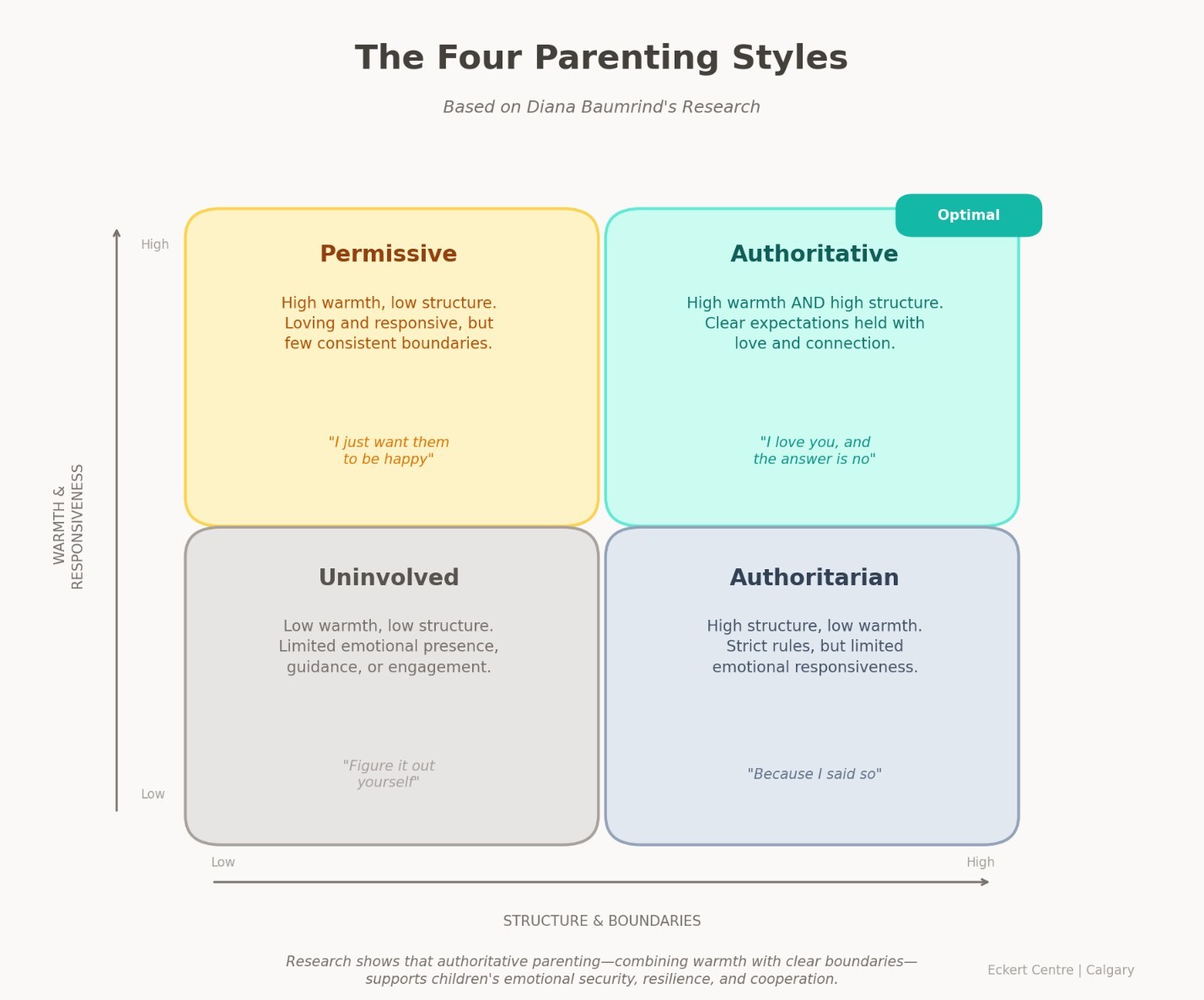
If we were to locate God’s “parenting style” on Baumrind’s quadrant, it would land in the “authoritative” quadrant below.
Dr. Chris Hanson is an American pediatrician who also holds a Doctor of Theology degree. His work focusses on how our image of God inevitably shapes our image of parenting.
For parents, this matters enormously. When God is imagined primarily as authoritarian, parenting often becomes rigid, fear-based, or compliance-focused. When God is imagined
as authoritative -- relational, loving, and responsive -- parenting tends to move toward empathy, guidance, and connection. God holds aspirations for human well-being while responding compassionately to real human choices, emotions, and struggles. Importantly, divine love does not disappear when people struggle, fail, or resist; instead, it adapts, responds, and opens new possibilities for growth.
Attachment Theory: Children Grow Through Secure Relationships
Attachment theory, pioneered by John Bowlby and expanded through the work of Mary Ainsworth, offers decades of research showing that children develop best within secure, responsive relationships with caregivers.
Bowlby described attachment as a biological and emotional system designed to keep children close to caregivers who provide protection, comfort, and guidance. Ainsworth’s research demonstrated that securely attached children:
Use their caregiver as a secure base from which to explore
Return to their caregiver as a safe haven when distressed
Develop stronger emotional regulation, confidence, and resilience
Attachment is not about perfect parenting. It is about consistent, responsive presence. Secure attachment develops when caregivers are generally available, attuned, and willing to repair relational ruptures when they occur.
Dr. Daniel Siegel, Harvard-trained psychiatrist, later integrated attachment theory with neuroscience, showing how attuned caregiving literally shapes the developing brain. Through repeated experiences of being understood and soothed, children build neural pathways for emotional regulation, empathy, and relational trust.
The Circle of Security: A Visual Bridge Between Theology and Psychology
One of the most helpful attachment-based frameworks for parents is the Circle of Security. It offers a simple visual map of children’s relational needs:
At the top of the circle, children need support for exploration
At the bottom of the circle, children need comfort, protection, and help organizing their feelings
Parents are invited to be the “hands on the circle,” consistently available as both secure base and safe haven.
When we look at this through a relational theology lens, the parallels are striking. God is portrayed in Scripture as both:
One who sends people out with courage, calling, and purpose
One who welcomes them back with compassion, forgiveness, and care
This rhythm of going out and coming back mirrors the attachment needs of all of us, including our children. Parenting that follows this rhythm reflects a theology of God who delights in growth while remaining steadfastly present in moments of fear or failure.
All of our Eckert Centre clinicians are trained in the Circle of Security parenting model.
The Four S’s: A Relational Blueprint for Parenting
The psychiatrist-psychotherapist author duo, Daniel Siegel and Tina Payne Bryson, describe secure attachment through what they call the Four S’: children need to feel Safe, Seen, Soothed, and Secure.
These four experiences align seamlessly with relational theology:
Safe
The world can be a hard place. Children need a home-base where they feel protected and freed from fear. Relational theology reminds us that God’s love does not threaten or coerce -- “there is no fear in love, but perfect love casts out fear” (1 John 4:18). Similarly, attachment-based parenting invites caregivers to be strong without being frightening – providing kind and firm boundaries that create safety rather than fear.
Seen
To be seen is to be known. Attunement-- noticing a child’s internal emotional world-- mirrors the theological conviction that God knows us intimately. Children who feel seen develop a deep sense of worth and belonging.
Soothed
God’s love is often described as comfort for the weary and refuge in distress. In parenting, soothing does not remove pain but ensures children are not alone in it. Over time, this external soothing becomes internal self-regulation.
Secure
Security emerges when safety, attunement, and comfort are repeated over time. This echoes the Christian vision of covenantal love, of faith rooted in trust -- not fear -- and relationship -- not performance.
Parenting as Co-Creation and Formation
Relational theology frames parenting as a form of co-creation. Parents are not merely enforcing rules; they are participating with God in shaping a child’s emotional, relational, and spiritual world. What you do is SO important!
Attachment research supports this deeply formative role. Everyday moments -- helping a child name feelings, repairing after conflict, delighting in who they are-- become powerful shaping experiences.
This approach shifts parenting from behavior management to relationship cultivation. Discipline becomes guidance. Authority becomes stewardship. Obedience becomes trust.
Repair, Grace, and Growth Over Time
One of the most freeing findings in attachment research is that parents do not need to get it right all the time. In fact, misattunements happen frequently. What matters most is repair.
Relational theology echoes this truth. God’s relationship with humanity is marked by grace, patience, and ongoing invitation.
Growth unfolds over time, not through perfection.
In parenting support counselling and family therapy, we often help parents learn how to:
Repair after conflict
Apologize without shame
Re-establish connection after rupture
Hold boundaries with compassion
These skills strengthen attachment and embody a lived theology of grace.
Why This Matters for Families Seeking Christian Faith-Based Counselling in Calgary
Families seeking faith-based counselling in Calgary are often navigating complex pressures, cultural expectations, church messages, parenting stress, and children’s emotional needs. When theology and psychology feel misaligned, parents can feel stuck or ashamed.
Integrating relational theology with attachment-based parenting offers a way forward that is both faithful and evidence-based. It reassures parents that:
Loving responsiveness is not permissiveness
Boundaries and empathy can coexist
Faith and neuroscience are allies, not enemies
In our private counselling psychology practice in North Calgary, parenting support counselling and family therapy can help parents reflect on their own attachment histories, their image of God, and how both shape their parenting responses today.
Moving Toward Secure, Faith-Filled Relationships
At its heart, both relational theology and attachment-based parenting proclaim the same truth: we are formed in relationship. Children flourish when love is dependable, responsive, and kind. Faith flourishes when God is experienced as present, trustworthy, and compassionate.
For parents longing to raise emotionally healthy children within a Christian faith framework, this alignment offers hope. You do not have to choose between faith and science, authority and empathy, structure and connection. When relational theology and attachment-based parenting come together, families are invited into a way of life marked by security, growth, and grace.
If you are exploring parenting support counselling or family therapy in Calgary, working with a counsellor who understands both attachment theory and Christian relational theology can help you build the kind of relationships that last -- grounded in love, shaped by wisdom, and sustained through connection.
Our Eckert Centre team of attachment, neurodiverse, and trauma-informed psychologists and counsellors in Calgary offers:
Family Therapy
Child/Teen Counselling
Parent Support Counselling
Individual Adult Counselling
And more!
We offer free 15 minute consultations and in-person counselling sessions in North Calgary, as well as secure online therapy anywhere in Alberta, including Airdrie, Cochrane, and Okotoks.
(403) 230-2959 | info@eckert-psychology.com | Book Online
About the Author
Jess Andrews is a Canadian Certified Counsellor (CCC) and Registered Psychotherapist (Qualifying) who works with adults and teens (16+) using a compassionate, trauma-informed, and integrative approach. Drawing on Internal Family Systems, somatic and mindfulness-based therapies, narrative and solution-focused work, and spiritually integrated care, Jess supports clients through grief and loss, emotional dysregulation, chronic health concerns, trauma, and questions of meaning or faith. With a background in nursing, hospital and university chaplaincy, and multi-faith spiritual care, she brings a calm, grounded presence to therapy—meeting each person where they are and supporting healing that honours their inherent wholeness.
References
https://www.circleofsecurityinternational.com/
Ainsworth, M. D. S., Blehar, M. C., Waters, E., & Wall, S. (2015). Patterns of Attachment. Routledge.
Hanson, C. (2025). Open and Relational Parenting: Loving Parents Reflecting a Loving God. Sacrasage Press.
Bowlby, J. (1980). Attachment and Loss: Vol. 1. Attachment. Basic Books.
Siegel, D. J., & Bryson, T. P. (2021). The Power of Showing Up: How Parental Presence Shapes Who Our Kids Become and How Their Brains Get Wired. Ballantine Books.
People Also Ask (FAQ)
Is attachment-based parenting the same as permissive parenting?
No. Attachment-based parenting is not about letting children do whatever they want. It is about holding clear, loving boundaries while staying emotionally present and responsive. This closely mirrors an authoritative (not authoritarian) approach to parenting—firm, kind, and relational.
Will this kind of counselling respect our Christian faith?
Yes. Our faith-based counselling honours Christian beliefs and values. We do not ask families to set aside their faith; instead, we explore how theology, parenting, and emotional health can support one another. Many parents find that this work deepens both their relationships and their faith.
Do I have to be a “perfect parent” for this approach to work?
Absolutely not. Secure attachment does not require perfection. It grows through repair, humility, and grace over time. Learning how to reconnect after conflict is far more important than getting everything right the first time.
Can this approach still include discipline and consequences?
Yes. Boundaries, guidance, and limits are essential for children’s sense of safety. Attachment-based parenting focuses on how discipline is delivered—grounded in relationship, explanation, and care—rather than fear, shame, or disconnection.
What if my own upbringing or image of God makes this feel hard?
Many parents notice that their own attachment history or theology shapes how they respond under stress. Counselling offers a compassionate space to reflect on this, heal what needs healing, and learn new ways of responding—without blame or judgment.
Is this counselling only for families in crisis?
Not at all. Many families seek counselling proactively—to strengthen relationships, align their parenting with their faith, or support a child through a developmental transition. You don’t need to be in crisis to benefit.
Do you offer faith-based counselling for parents even if children don’t attend?
Yes. Parent support counselling can be deeply effective on its own. When parents shift how they understand and respond to their children, the whole family system often changes.
What ages does this approach work for?
Attachment-informed, relational approaches are effective from early childhood through adolescence—and even into adulthood. The principles adapt as children grow.