
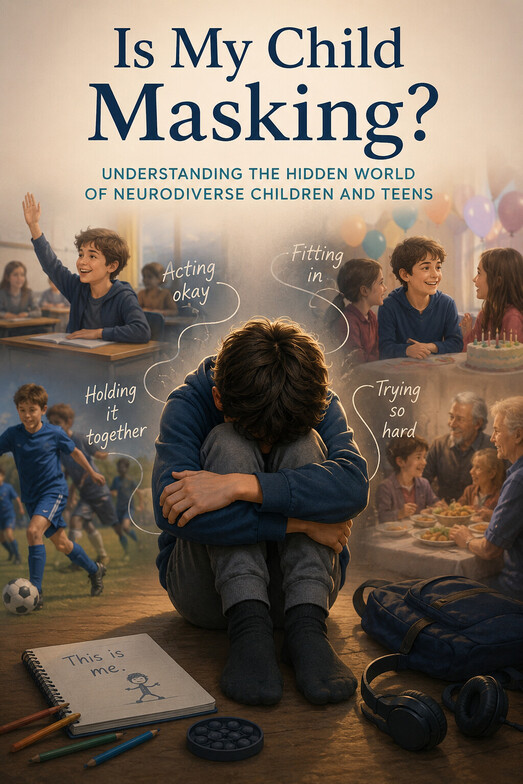
Think about the child who holds it all together beautifully in every room they enter. They sit patiently at the dentist. They smile their way through a birthday party. They ace a presentation. They are gracious with grandparents over Sunday dinner. And then they get home, and something breaks open entirely. The smallest thing, a wrong-coloured cup, a homework reminder, the sound of the television, and suddenly you are watching your child come completely undone.
You have probably been told: “They were great today.” And you believe it. You still cannot reconcile that child with the one currently on the kitchen floor.
What you are witnessing is the aftermath of masking. And it is one of the most misunderstood experiences in the lives of neurodiverse children and teens. This post is meant to give you a real understanding of what masking is, what it costs, and where it shows up in your child’s life beyond the obvious.
What Masking Actually Is
Masking, also called camouflaging, is the process by which a neurodiverse person suppresses, mimics, or compensates for their natural neurological responses in order to appear more “typical” to those around them. It was first described in research on autistic individuals, but we now understand it applies broadly to anyone whose brain processes the world differently, including those with ADHD, sensory processing differences, and anxiety. It is important to understand that masking is not one single behaviour. It operates on two distinct layers that often happen at the same time:
Social camouflaging is the active effort to imitate and blend in. This includes mirroring other people’s body language, rehearsing what to say before speaking, forcing eye contact, suppressing stimming (rocking, hand-flapping, fidgeting), and performing emotions that feel expected rather than authentic.
Compensatory strategies refer to the behind-the-scenes mental work used to manage what others never see. This includes memorizing scripts for common social situations, mentally replaying conversations afterward to evaluate whether they went “right,” applying conscious rules to navigate interactions that come naturally to neurotypical peers, and using enormous cognitive effort to appear organized, attentive, or calm.
Here is what makes masking so depleting: neither of these layers switches off simply because the setting feels safer. Over time, many neurodiverse children do not even know they are doing it. The mask becomes automatic. And when it finally slips, it does not look like relief. It looks like dysregulation.
Why the Brain Masks in the First Place
Masking is not a choice in any meaningful sense. It is a survival response.
Neurodiverse brains are often exquisitely attuned to social feedback. When a child learns through experience that their natural way of moving, speaking, reacting, or engaging draws correction, confusion, or rejection, they begin adapting. The adaptation is usually invisible to everyone, including the child themselves. It is the nervous system doing what nervous systems do: learning what feels safe and what does not, then adjusting accordingly.
For many neurodiverse children, the world sends a consistent message that their natural self does not quite fit. The social rules feel arbitrary but unavoidable. The sensory environment feels overwhelming but manageable if they just push through. The expectation to maintain eye contact, sit still, respond quickly, and follow along without additional support is relentless. So they comply. Visibly. At great internal cost.
The painful irony is that a child who masks effectively is often praised for it. “She’s so mature.” “He really stepped up.” “They did so well.” The positive reinforcement teaches the brain that the performance is worth the price. And the price keeps rising.
Where Masking Shows Up Beyond School
Most conversations about masking focus on school, and for good reason. But masking is not confined to classrooms. It surfaces anywhere a neurodiverse child or teen feels pressure to perform normalcy. Understanding the full range helps parents recognize when their child might be burning through reserves they do not have.
Extracurricular activities and sports
Sports teams, music lessons, drama clubs, and recreational programs often carry just as much social pressure as school, sometimes more. A hockey dressing room has its own unwritten culture. A dance class has its social hierarchy. A team sport requires reading group dynamics in real time while also performing the physical task. For a neurodiverse child who genuinely loves the activity, the masking required to participate can completely undercut the benefit of being there. Watch for a child who loves soccer in theory but comes home from practice depleted, irritable, or withdrawn.
Family gatherings and holidays
Extended family events are sensory and social gauntlets. Loud environments, unpredictable schedules, physical affection from relatives who feel unfamiliar, sustained small talk, and the pressure to appear grateful and engaged all demand constant performance. The fact that it is family does not reduce the cost. The meltdown in the car on the way home, or the two-day shutdown after Christmas, is often the exhale after hours of sustained masking. The length of the recovery period is often a more accurate gauge of how hard a child worked than how they appeared during the event.
Peer social events
Birthday parties, sleepovers, and group social events require an enormous amount of social reading that neurodiverse children often find genuinely difficult. Who is talking to whom? What is the joke, and am I supposed to laugh? Am I standing too close? Did that pause mean something? For many neurodiverse teens especially, peer social situations feel like sitting an exam in a language they only partially speak. They can pass. But it costs them significantly.
Online and social media spaces
It might seem like online spaces would offer relief from in-person performance demands. For some neurodiverse teens, they do. But social media introduces its own version of masking: the curated self. The pressure to appear confident, funny, and socially successful online can be just as taxing as in-person performance, particularly for teens who are already uncertain about who they are underneath the mask. The comparison dynamics of social platforms can reinforce the belief that their authentic self is something to hide.
Medical and therapeutic appointments
This one surprises many parents. A child or teen who masks effectively may present as calm, organized, and articulate in a 50-minute appointment even when they are struggling profoundly. This is one reason why neurodiverse presentations, particularly in girls and teens, are frequently underdiagnosed or missed entirely. The child who “interviewed well” and “didn’t seem that affected” may simply be a very skilled masker. A clinician who does not account for this can miss what matters most.
How Masking Looks Different in Teens
In younger children, masking tends to show up physically. The child who holds in every sensory reaction during class and cries in the car. The one who is perfectly compliant at school and explosive at home. The one who mirrors other kids so thoroughly that they seem to have no particular personality of their own.
In teenagers, masking becomes more psychologically complex. Adolescence is when identity forms. Sustained masking during this period can interfere with that process in serious ways.
A teenager who has spent years performing a version of themselves that fits in may genuinely not know who they are when the performance stops. They may feel hollow, detached, or profoundly confused about their own preferences, values, and sense of self. This can look like depression or anxiety, and often it is, because sustained masking is associated with both. It can also be the beginning of what researchers call autistic burnout: a state of deep exhaustion where the capacity to mask breaks down entirely, and the teen may withdraw, stop functioning in daily life, and need significant time and support to recover.
Teenage girls in particular deserve mention here. Research is consistent: girls are far more likely to mask, more thoroughly, and for longer before being identified. They are praised for the emotional attunement and social awareness that may actually be compensation. By the time they arrive at a clinician’s office, the gap between their internal experience and their external presentation can be enormous.
The Identity Cost of Long-Term Masking
There is a question some neurodiverse teens and adults eventually arrive at, often in therapy: “I have been performing this version of myself for so long that I do not know who I actually am.”
This is not dramatic. It is a real consequence of years of suppressing authentic responses, preferences, and ways of moving through the world. When a child learns early that their natural self is somehow “too much” or “not enough,” they do not just learn to hide it in public. Over time, they can lose access to it entirely.
This is why identity work is such an important part of therapy for neurodiverse teens and young adults. Not just coping strategies or symptom management, but the slower, more nuanced work of figuring out what they actually feel, what they genuinely want, and how they truly move through the world when no one is watching.
Recovery from long-term masking often involves grief: grieving the years spent performing normalcy, grieving relationships built on a mask rather than a self, and slowly building permission to exist authentically. That grief is real. And it is also the beginning of something much better.
What Parents Can Do
Understanding masking does not mean you can fix it overnight. But it changes how you interpret your child’s behaviour, and that shift matters more than any single technique.
Create a recovery zone at home. When your child comes home depleted, resist the urge to debrief, redirect, or problem-solve. Give them 20 to 30 minutes of no demands and no questions. Let them choose how to decompress.
Name the invisible work. Try: “I know being around people takes a lot out of you. I’m glad you’re home.” This lands differently than praise for how well they performed.
Let the mask come off at home. Where possible, reduce the demand to perform at home. Stimming, movement, solitude, blunt communication, unusual interests: these should be welcome, not corrected.
Question the praise. If your child is consistently described as fine in every setting, that is worth examining rather than simply celebrating. Fine is not the same as okay. Look at the full picture, not just school. Pay attention to how your child recovers after extracurriculars, family events, and social outings. Recovery time is often a more honest signal than in-the-moment behaviour.
Seek a clinician who understands masking. A thorough assessment from someone who accounts for masking is worth pursuing if you suspect your child’s needs have been missed or minimized.
When It’s Time for More Support
If your child is consistently depleted after social situations across multiple contexts, if their capacity to function is narrowing, if they are expressing confusion about who they are, or if you sense a growing gap between how they appear and how they are actually doing, those are meaningful signals worth taking seriously.
Therapy grounded in neurodiversity-affirming approaches offers your child a space where they do not have to mask at all. A therapist who understands how these presentations develop can hold space for both the complexity of neurodiverse identity and the very real toll of years of performance. For teens especially, our teen counselling in Calgary creates exactly this kind of space. And for parents navigating this alongside your child, our parent support for families with special needs gives you space to process what you are witnessing and to learn how to advocate effectively.
Ready to Take the Next Step?
If this has brought something into focus for you, we would love to connect. Our team at Eckert Psychology & Education Centre understands the full complexity of neurodiverse experience, and we are here for your whole family.
Book a free 15-minute consultation or schedule your first appointment:
(403) 230-2959 info@eckert-psychology.com Book Online Here
About the Author
Michael Szabo, MACP, is a Registered Provisional Psychologist at Eckert Psychology & Education Centre in Calgary. Michael works with adults, teens, and families, including those on the neurodiversity spectrum. From autism to ADHD to trauma, his goal is to help build an appreciation for your individual brain style and sense of worth. His approach centers on creating a space where you can explore your experiences with curiosity and compassion.
References
Cage, E., & Troxell-Whitman, Z. (2019). Understanding the reasons, contexts and costs of camouflaging for autistic adults. Journal of Autism and Developmental Disorders, 49(5), 1899–1911.
Hull, L., Petrides, K. V., Allison, C., Smith, P., Baron-Cohen, S., Lai, M. C., & Mandy, W. (2017). “Putting on my best normal”: Social camouflaging in adults with autism spectrum conditions. Journal of Autism and Developmental Disorders, 47(8), 2519–2534.
Lai, M. C., Lombardo, M. V., Auyeung, B., Chakrabarti, B., & Baron-Cohen, S. (2015). Sex/gender differences and autism: Setting the scene for future research. Journal of the American Academy of Child and Adolescent Psychiatry, 54(1), 11–24. Pearson, A., &
Rose, K. (2021). A conceptual analysis of autistic masking: Understanding the narrative of stigma and the illusion of inclusion. Autism in Adulthood, 3(1), 52–60.




Frequently Asked Questions
Masking shares core features across both, but can look different. A child with ADHD may suppress physical hyperactivity, over-explain themselves to appear organized, or perform attentiveness while internally overwhelmed. An autistic child may mask by scripting conversations, suppressing stimming, or forcing eye contact. Many children have overlapping presentations, and masking compounds across both.
Yes, and this is one of the most consequential effects of masking. A child who performs well in clinical interviews, appears organized at school, and does not display “textbook” symptoms in observable settings can be assessed as not meeting criteria, even when their internal experience is significantly distressing. This is particularly common for girls, and for children from families where high achievement is both modelled and expected.
Autistic burnout is not simply being tired. It is a profound depletion of the capacity to function, often following a prolonged period of sustained masking or heightened demands. It can include a loss of previously held skills, significant withdrawal, emotional flatness, and an inability to manage daily tasks that were previously manageable. Recovery typically requires a meaningful reduction in social and performance demands, and can take weeks or months.
The most telling indicator is the recovery pattern. A shy or quiet child who is genuinely comfortable may simply need warm-up time in new situations. A masking child tends to show a consistent pattern of sustained compliance in structured settings followed by significant dysregulation in safe settings. The gap between public and private presentation, combined with the intensity of the private response, is the signal worth paying attention to.
Yes, and this is often the most meaningful part of the therapeutic work. Neurodiversity-affirming therapy goes beyond coping strategies to help a person reconnect with who they genuinely are underneath years of performance. For teens especially, this work can be genuinely transformative, and it often requires a therapist who understands not just the clinical picture but the specific experience of having spent years trying to be someone else.
