
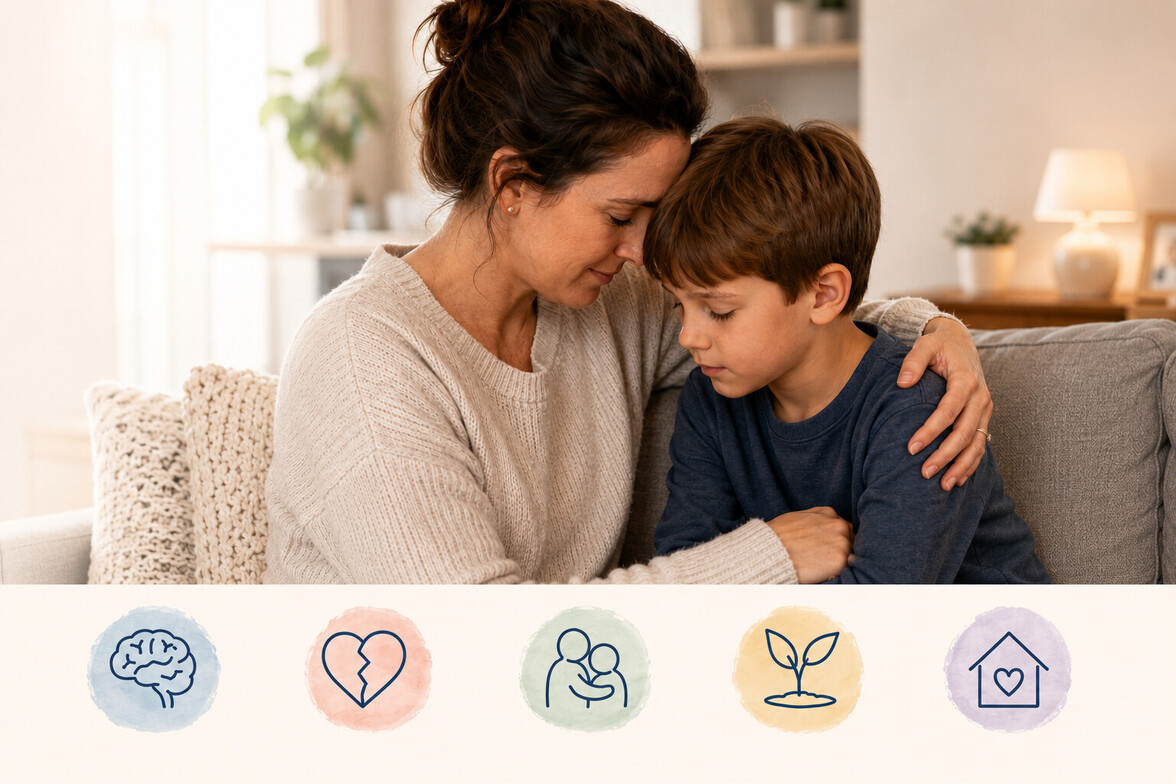
It’s 7:50 a.m., and you’re already running behind. Shoes are missing. Lunches are half-packed. And your child has chosen this exact moment to dig in their heels over something small. Before you’ve had a chance to think, your voice comes out louder and sharper than you meant it to. By the time the car pulls out of the driveway, your stomach is already in knots.
Here’s what makes that guilt sit so heavy: it’s rarely about the ten seconds you raised your voice. It’s about what that moment seems to say about you as a parent. Underneath, your own nervous system was likely overloaded too — running on too little sleep, too many demands, too little space to think. None of that makes yelling okay, but it does make it human. And the fear under the guilt is usually bigger than the moment itself: Will this hurt them? Will they remember me as the parent who yelled?
Here’s the genuinely hopeful, research-informed answer: what shapes a child’s long-term resilience isn’t whether disconnection happens. It’s whether repair follows. Children don’t need parents who never lose their temper. They need parents who come back. Learning to repair well, and often, is one of the most powerful — and teachable — parenting skills there is.
Why Repair Matters More Than the Rupture Itself
Attachment researchers behind Circle of Security Parenting describe the parent’s job in simple, memorable terms: to be “bigger, stronger, wiser, and kind” — a secure base a child can return to after every storm. No relationship, however loving, manages to avoid disconnection altogether. Tired parents yell. Patient parents snap. That isn’t a flaw in the system; it’s the system.
What predicts a child’s long-term security isn’t a flawless track record of calm parenting. It’s whether a caregiver consistently re-establishes connection after things go sideways. Each repair becomes a small, repeated lesson: this relationship can survive hard moments. I don’t have to be perfect to be loved — and neither do you. Over hundreds of small ruptures and repairs, children build an internal sense that relationships are sturdy rather than fragile, which is, at its core, what secure attachment is.
What’s Happening in Your Child’s Brain — and Yours
Dr. Dan Siegel and Dr. Tina Payne Bryson describe a “Yes Brain” as one that is balanced, resilient, insightful, and empathic — able to meet life’s challenges with curiosity rather than fear. When you raise your voice, your child’s more reactive, “downstairs” brain takes over: fight, flight, or shutdown. Reasoning, perspective, and empathy go offline — in your child, and often in you too.
This is exactly why the moment right after a yell matters so much. A calm, warm reconnection helps your child’s “upstairs” brain — the part responsible for regulation, judgment, and empathy — come back online and link up with what just happened. Their nervous system gets the signal: the danger has passed, the connection is intact, I am safe again. Repeated often enough, this is literally how a developing brain learns to recover from stress and return to balance — the foundation of the resilience every parent hopes to build.
Guilt vs. Shame: Modeling “Two Things Can Be True”
Psychologist Dr. Becky Kennedy, author of Good Inside, offers parents a phrase worth keeping close: two things can be true at once. I lost my temper this morning, and I am a good, loving parent. I made a mistake, and I am still someone my child can trust.
This distinction matters because guilt and shame do very different things. Guilt says, “I did something I regret,” and tends to motivate repair. Shame says, “I am bad,” and tends to motivate hiding or self-punishment — which a child can absorb just as easily as the original yell. When you repair out loud, briefly and without a long apology speech or self-flagellation, you’re not just smoothing over a hard moment. You’re demonstrating, in real time, that mistakes don’t erase someone’s worth — a lesson your child will carry into their own friendships, their own future relationships, and their own moments of getting it wrong.
Why Kids Actually Need You to Come Back
Developmental psychologist Gordon Neufeld describes children as wired for interdependence — they rely on their attachment relationship the way a plant relies on soil. A young nervous system can’t regulate itself in isolation; it borrows calm from a parent’s regulated presence. That borrowing only works when the relationship feels safe and intact.
A rupture, especially a yell, can register to a child’s nervous system as a threat to that closeness — not because they’re being manipulative or fragile, but because connection is genuinely how their brain and body stay regulated. This is part of why difficult behavior so often shows up after a hard moment between parent and child: the child is, in effect, asking for the relationship back. Repair isn’t a nicety layered on top of good parenting. It’s how you restore the secure base your child’s nervous system depends on to keep growing, exploring, and coping with the world.
If this pattern feels bigger than an occasional hard morning — if it touches old wounds of your own around connection and safety — attachment-focused therapy can help you and your child rebuild that secure base together.
A Simple, Doable Repair Script
You don’t need a perfect speech. Therapist Eli Harwood, author of Raising Securely Attached Kids, and mindfulness teacher Hunter Clarke-Fields, author of Raising Good Humans, both point to the same truth: it’s the repeated repair, not the eloquence of it, that builds security over time. Here’s a script you can adapt for almost any age:
- Regulate yourself first. Even 60 seconds of slow breathing helps — you can’t offer calm you don’t have. Clarke-Fields calls this giving yourself “permission to be human” before trying to reconnect.
- Get physically close, at eye level. Proximity itself communicates safety before you say a word.
- Name what happened, simply. “I yelled. That wasn’t fair to you. I’m sorry.” No lengthy explanation required.
- Reassure the relationship, not just the behavior. “You didn’t do anything to make me stop loving you. I’m here.”
- Save teaching for later. Once everyone is calm — sometimes hours later — is the time for problem-solving, not in the repair moment itself.
Repeated often enough, these small repairs are what your child’s nervous system actually remembers.
Restoring Connection: The Real Curriculum of Resilience
Resilience isn’t built by avoiding conflict. It’s built by living through enough ruptures and repairs that a child learns, in their body as much as their mind: relationships can survive hard moments. Mistakes don’t end love. I am still wanted, even on my worst mornings. That lesson, repeated hundreds of times across childhood, is one of the most protective things a parent can offer.
If yelling-and-guilt cycles feel stuck in your family, or you’d like support building these skills together, our team offers family therapy, child counselling, and parent support counselling right here in Calgary, with secure online sessions available across Alberta. You deserve support too — not just your child.
(403) 230-2959 | info@eckert-psychology.com | Book Online
References
Clarke-Fields, H., & Naumburg, C. (2019). Raising good humans: A mindful guide to breaking the cycle of reactive parenting and raising kind, confident kids. New Harbinger Publications.
Harwood, E. (2024). Raising securely attached kids: Using connection-focused parenting to create confidence, empathy, and resilience. Sasquatch Books.
Hoffman, K., Cooper, G., Powell, B., & Benton, C. M. (2017). Raising a secure child: How Circle of Security Parenting can help you nurture your child’s attachment, emotional resilience, and freedom to explore. The Guilford Press.
Kennedy, B. (2022). Good inside: A guide to becoming the parent you want to be. Harper Wave.
Neufeld, G., & Maté, G. (2004). Hold on to your kids: Why parents need to matter more than peers. Ballantine Books.
Siegel, D. J., & Bryson, T. P. (2018). The yes brain: How to cultivate courage, curiosity, and resilience in your child. Bantam.
Kymberley Calhoun, M.C., is a Registered Psychologist at Eckert Psychology & Education Centre in Calgary, specializing in child, adolescent, parent, and perinatal mental health. Her attachment-informed, neurodiversity-affirming approach draws on training in Circle of Security Parenting, EMDR, and Theraplay, helping families build calmer, more connected relationships at home.




Frequently Asked Questions
Occasional yelling is common, and research on attachment suggests it’s the pattern of repair afterward — not the rupture itself — that shapes a child’s long-term emotional security. Consistent, warm reconnection after a hard moment is what protects the relationship.
A simple repair usually includes pausing to calm your own body, getting close to your child, naming what happened in a few words, and reassuring them that the relationship is intact. Save any teaching or consequences for a calmer moment later.
Keep it brief and honest: something like, “I yelled, and that wasn’t fair to you. I’m sorry. You didn’t do anything to make me stop loving you.” Children respond more to a calm, reassuring tone than to a long explanation.
Yes. Most parents raise their voice at some point, especially under stress or fatigue. What matters most for a child’s development is whether a caregiver reliably reconnects and repairs afterward.
Each repair teaches a child that relationships can survive hard moments and that mistakes don’t end love or connection. Over time, this repeated experience helps build the emotional security and self-regulation skills associated with resilience.
