
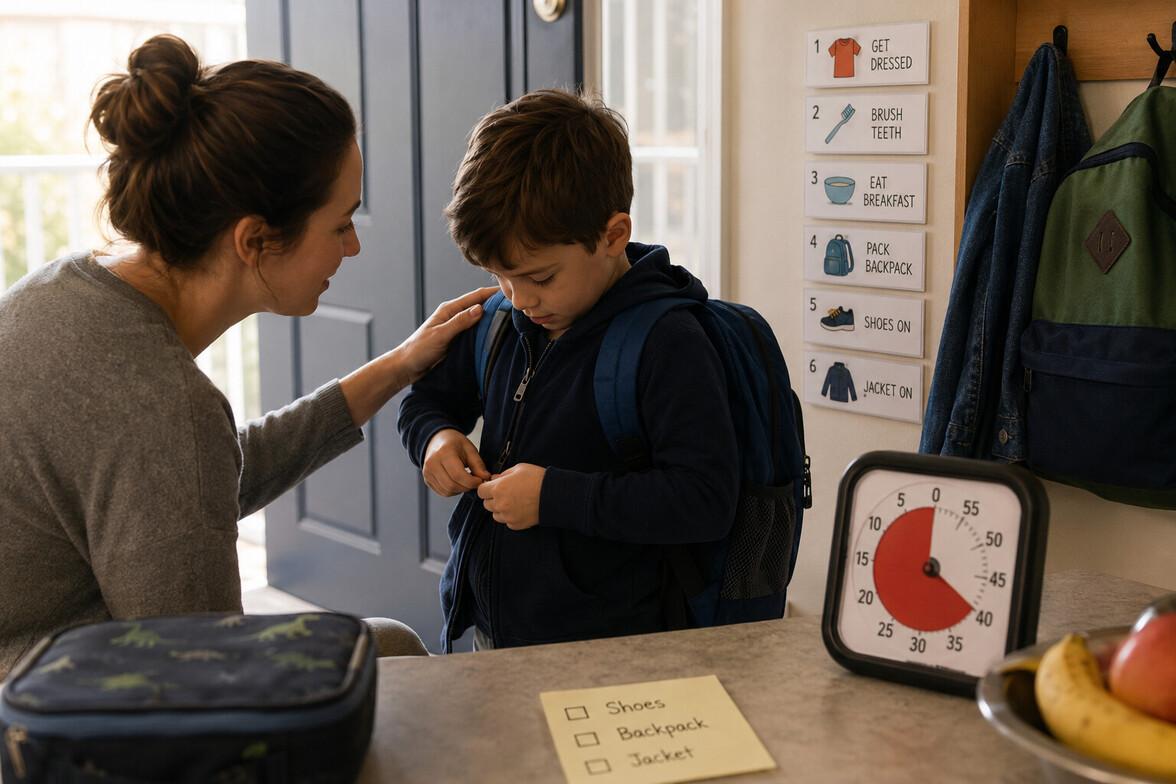
It’s 8:12am. Shoes are missing, breakfast is untouched, and you’ve asked your child to put on their backpack four times. You’re not losing your patience because you’re a bad parent. You’re losing it because you’ve been doing this every single morning, and nothing seems to change.
If your child has ADHD, mornings aren’t just rushed. They’re a daily collision between what the clock demands and what their brain can actually do under pressure. Understanding that difference won’t solve everything overnight, but it will change how you approach it, and that matters more than any chart or timer on its own.
Why Mornings Are Genuinely Harder for Kids With ADHD
Most morning routines assume a child can feel time passing, hold a sequence of steps in mind, and shift from rest to full-demand mode without much support. For a neurotypical child, that’s a reasonable ask. For a child with ADHD, each of those things is a real neurological challenge.
Time blindness is one of the most underappreciated parts of ADHD. Your child is not ignoring the clock. They genuinely cannot feel the difference between five minutes and twenty. When you say “we leave in ten minutes,” that information doesn’t register the way it does for you. It dissolves almost immediately.
Working memory gaps make multi-step tasks collapse. Getting ready in the morning can involve a dozen or more sequential steps depending on how you count them. For a child with ADHD, completing step three often means losing track of steps four and five entirely. It’s not laziness. It’s a brain that struggles to hold a chain of instructions while also executing them.
Then there’s the transition itself. Moving from sleep or free play into a high-demand, time-pressured environment is genuinely hard for most kids. For a child with ADHD, that shift is harder still. Their nervous system needs more time and more support to make it, and mornings rarely offer either.
Why the Usual Fixes Often Fall Short
Parents of kids with ADHD have usually tried everything by the time they look for outside support. Reward charts, countdowns, consequences, sticker systems. And it’s worth saying clearly: those approaches are not wrong. They just need to be applied differently than most parents expect.
Reward charts can work for kids with ADHD, but they need to be immediate and highly consistent. A sticker at the end of the week is too far away for a brain that discounts future rewards quickly. If charts haven’t worked, the timing and frequency of the reward is likely the issue, not your child.
For many kids with ADHD, the issue isn’t that they don’t want to cooperate. It’s that wanting to do something and being able to initiate and sustain it are two different neurological processes, and ADHD affects both. External structure helps bridge that gap in ways that willpower and motivation alone cannot.
Verbal reminders feel like help but often add to the problem. Every “did you brush your teeth yet?” is a new cognitive demand arriving while your child is already trying to manage several others. It can push them further into overwhelm rather than forward through the task.
Consequences after the fact, like losing screen time because they were slow, rarely improve the next morning. Kids with ADHD struggle to connect a future consequence to a present behaviour in a way that changes what they do in the moment. When consequences are used, pairing them with immediate feedback works far better than delayed ones.
What Actually Helps
These strategies work not because they motivate better, but because they reduce the demands the morning puts on an already-stretched system.
Reduce decisions the night before. Think about the night before as your real morning prep. Clothes chosen, bag packed, lunch made or at least planned. Every decision you remove from the morning is one less thing your child’s brain has to manage before 8am. This alone can cut conflict in half.
Replace verbal countdowns with visual timers. A Time Timer or even a kitchen timer on the counter gives your child something external to track instead of relying on an internal sense of time they don’t have. “The red is almost gone” is more concrete than “five minutes.”
Shrink the sequence. Pick the three non-negotiables, shoes, backpack, and jacket, for example, and let the rest go temporarily while you build the habit. Trying to fix the whole routine at once usually means fixing none of it. Starting small builds momentum.
For some kids, anchoring the routine to a sensory cue can help. A specific playlist that plays only on school mornings, or a particular breakfast that signals the start of the routine, can act as a reliable on-ramp for a brain that struggles with transitions. If this resonates with how your child responds to predictable cues, it’s worth experimenting with.
Build in a buffer before the door, not after. If your child needs ten minutes to decompress before they can engage, give it to them at the start rather than rushing out and hoping they settle in the car. A calmer departure, even if it means leaving a few minutes earlier, tends to cost less than a dysregulated exit.
When Mornings Are Telling You Something Bigger
For most families, these strategies will help. But if mornings remain a source of daily crisis despite consistent effort, it’s worth asking what else might be contributing.
Persistent morning dysregulation can point to unaddressed anxiety, disrupted sleep, or an ADHD presentation that hasn’t been fully understood. Some kids are carrying sensory sensitivities, emotional regulation challenges, or school-related stress that makes the starting line of every day feel impossible before it begins.
If your child has never had a formal assessment, that’s worth considering. A good assessment doesn’t just confirm or rule out ADHD. It maps out your child’s specific profile, where they struggle, where they’re strong, and what kinds of support are most likely to help. That information changes how you parent, how teachers teach, and how your child understands themselves.
You can learn more about ADHD assessments for children in Calgary and what the process looks like on our website.
Mornings Can Get Better
They may never be effortless. But they can stop feeling like a daily rupture between you and your child.
The shift that matters most is moving from “why won’t they just do it” to “what does their brain need to make this possible.” That’s not about lowering expectations. It’s about building the right conditions so your child can actually meet them.
Small structural changes, matched to how your child’s brain actually works, make a real difference over time. And when you want support beyond strategies, help is available.
If mornings have become a consistent source of conflict and the usual approaches aren’t landing, our team offers child counselling in Calgary and parent support counselling for families navigating exactly this. You don’t have to figure it out alone. Book a 30-minute consultation at eckertpsychology.janeapp.com or call us at (403) 230-2959.
About the Author
Michael Szabo, MACP, Registered Provisional Psychologist, works with adults, teens, and families on the neurodiversity spectrum. From autism to ADHD to trauma, Michael’s goal is to help build an appreciation for your individual brain style and worth. His approach centers on creating a space where you can explore your experiences with curiosity and compassion.




Frequently Asked Questions
ADHD affects the brain’s ability to regulate time, maintain working memory, and initiate tasks. Morning routines require a child to complete a sequence of steps under time pressure, which directly challenges all three of these areas. This is not a behaviour or willpower problem.
Time blindness is the difficulty feeling time passing, which is common in ADHD. Your child may genuinely not perceive the difference between two minutes and twenty. This is why verbal countdowns are less effective than visual timers, which give the brain an external reference to work with.
They can, but only when the reward is immediate and highly consistent. A sticker at the end of the week is too far in the future for an ADHD brain, which tends to discount delayed rewards quickly. If charts haven’t worked, adjusting the timing and frequency of the reward is worth trying before abandoning them.
The most effective strategies reduce demands on the brain rather than relying on motivation alone. Preparing the night before, using visual timers instead of verbal reminders, simplifying the routine to a few non-negotiables, and building in transition time before the door can all significantly reduce morning conflict.
If morning struggles are part of a broader pattern of difficulty with organization, attention, or emotional regulation at school and home, a formal assessment can clarify what is going on. An assessment does not just confirm or rule out ADHD. It maps your child’s specific profile and informs the kind of support that will actually help.
Not necessarily, but persistent dysregulation that does not improve with structural changes may point to unaddressed anxiety, sleep issues, or emotional regulation challenges that therapy can help with. Child counselling or parent support counselling can be useful when the patterns are affecting the whole family.
