
You love your children fiercely. You also find yourself saying yes when you mean no, avoiding their disappointment, or wondering if holding a limit makes you "the bad guy." Somewhere along the way, many parents absorbed the message that warmth and boundaries are opposites—that you have to choose between connection and structure.
But what if that's not true? What if both the research and the lived experience of families who've done this work tell a different story?
A False Choice We've Been Handed
Many parents feel caught between two extremes. On one side, there's the "fun parent" who keeps the peace, avoids conflict, and prioritizes their child's happiness in every moment. On the other, there's the "strict parent" who holds firm limits but worries they're being cold, harsh, or damaging the relationship.
This either/or thinking keeps parents stuck.
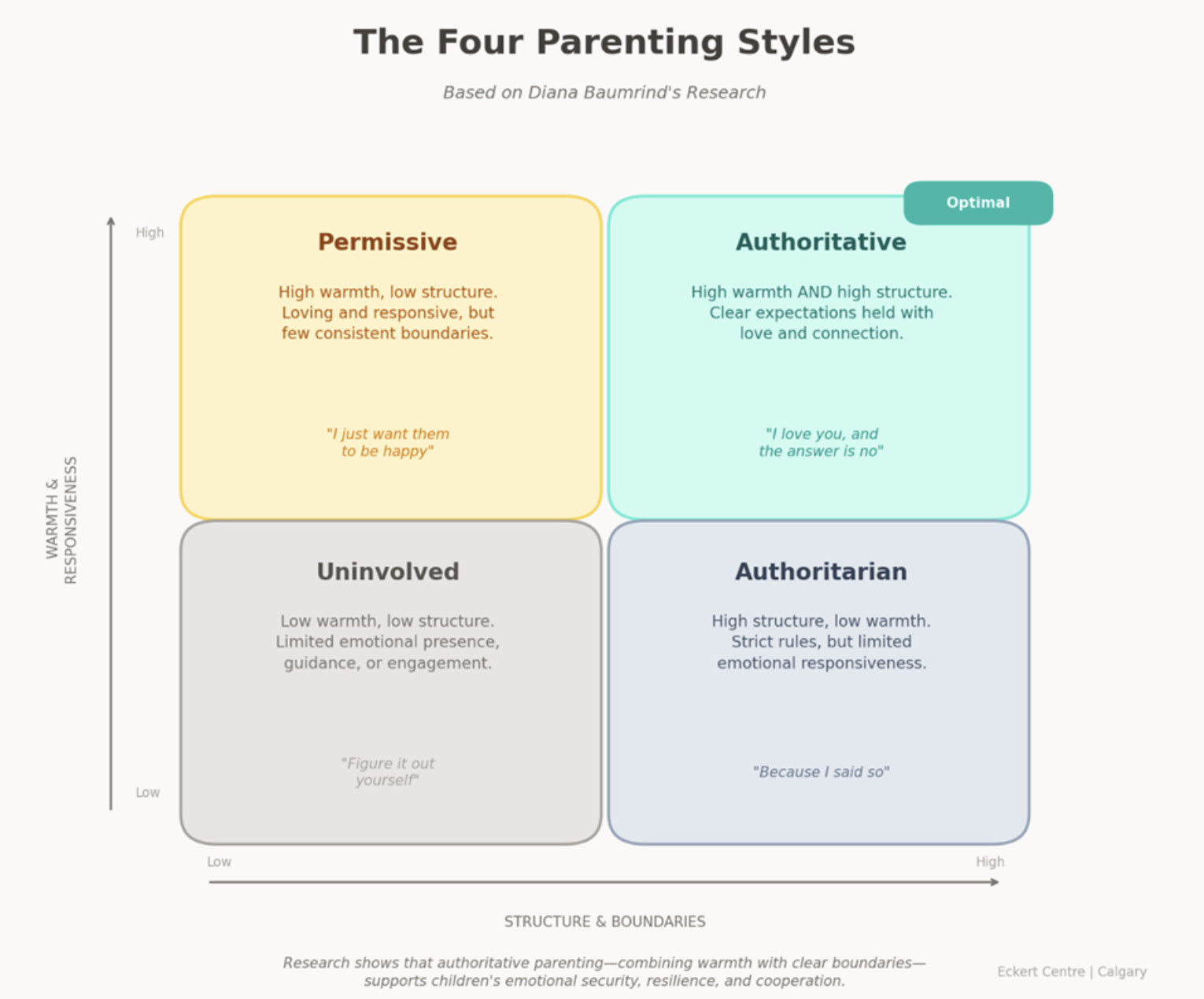
Psychologist Diana Baumrind's research on parenting styles helps us see the landscape more clearly. She identified four main approaches:
• Permissive parenting: High warmth, low structure. Lots of love, but few consistent limits.
• Authoritarian parenting: High structure, low warmth. Rules are enforced, but connection takes a back seat.
• Uninvolved parenting: Low warmth, low structure. Neither emotional presence nor boundaries.
• Authoritative parenting: High warmth AND high structure. Love and limits working together.
Here's what matters: authoritative parenting isn't a compromise or a middle ground between warmth and firmness. It's a both/and approach—one where connection and boundaries are partners, not opponents.
Why This Feels So Hard
If you've leaned toward permissive parenting, you're not alone. Many loving, well-intentioned parents find themselves here—and there are real reasons why setting boundaries with your child feels so uncomfortable.
For some parents, firmness triggers memories of their own childhood. If boundaries were harsh or punishing when you were young, setting limits with your own children can feel dangerously close to repeating that pattern. The internal alarm bells go off: Am I being too strict? Will they remember this moment and resent me?
For others, boundaries were largely absent growing up. You may not have a felt sense of what healthy limits even look like—so when you try to hold one, it feels foreign and uncertain.
As authors Henry Cloud and John Townsend write in their book Boundaries, we often struggle to give our children what we didn't receive ourselves. Or we swing to the opposite extreme, overcorrecting in ways that leave us feeling unmoored.
And then there's parenting guilt—that knot in your stomach when your child cries because you said no. The voice that whispers you're damaging them, pushing them away, being "mean."
Here's what I want you to know: that guilt is not evidence that you're doing something wrong. It may simply mean you're in unfamiliar territory. And unfamiliar territory can become home with support, practice, and self-compassion.
Boundaries That Build Connection
It sounds counterintuitive, but children feel more secure—not less—when parents hold clear, consistent limits.
Cloud and Townsend offer a helpful reframe: boundaries are not walls that push people away. They're fences with gates. They define what's okay and what isn't, while keeping the relationship intact. They communicate something profound to your child: I see you. I love you. And I'm strong enough to keep you safe.
Without boundaries, children often feel anxious. They test limits more, not less, searching for the container they need. Permissive parenting can inadvertently signal: "Your big feelings are too much for me to handle." And that message, however unintentional, increases a child's anxiety rather than reducing it.
Authoritative parenting offers something different. It holds warmth and structure together through:
• Responsiveness: You're emotionally present and attuned to your child's needs.
• Clear expectations: Your child knows what's expected and can count on consistency.
• Communication: You explain the "why" behind limits—without endlessly negotiating.
And here's a crucial shift: healthy boundaries in parenting aren't about controlling your child. They're about being clear about your own limits and what you will or won't do.
Instead of "You need to go to bed right now," try: "Bedtime is 8:00. I'm available to tuck you in until 8:15, and then I'll be heading downstairs."
The difference is subtle but powerful. You're not demanding compliance. You're stating what's true and what you'll do—and letting your child navigate their response within that container.
Practical Ways to Hold Warmth and Boundaries Together
Name the boundary AND the love. "I love you, and bedtime is 8:00." Both things are true. Your child doesn't need you to choose.
Get comfortable with your child's disappointment. Your child's disappointment is not an emergency. You can validate their feelings—"I know you wanted more screen time, that's frustrating"—without rescinding the limit.
Focus on what YOU will do. "If you're not dressed by 8:00, I'll be leaving without breakfast being ready" is clearer and more enforceable than "You need to hurry up."
Expect testing. When you start holding limits more consistently, children often push harder at first. This isn't failure—it's your child checking to see if the new fence is real. Stay the course.
Build in repair. You won't do this perfectly. When you lose patience, a simple "I got frustrated and raised my voice. I'm sorry. I'm still holding that boundary, and I love you" models accountability and keeps connection intact.
You Get to Be Both
Here's what I hope you'll carry with you: warmth and boundaries are not opposites. They are partners.
The research on authoritative parenting consistently shows that children raised with both high warmth and clear structure tend to be more secure, more resilient, and more cooperative—not because they're controlled, but because they feel safe.
If you've leaned permissive and you're wondering how to shift, the discomfort you feel when holding limits is not a sign you're causing harm. It's simply unfamiliar. And with support and practice, it can become the foundation for the connected, boundaried family life you're longing for.
You don't have to choose between being loving and being firm. You get to be both.
Taking the Next Step
If you're navigating boundaries, child behaviour, and the question of how to be the parent you want to be, you don't have to figure this out alone.
At Eckert Centre, our counsellors and psychologists work with parents using approaches like attachment-focused therapy and Circle of Security to help you understand your child's needs, your own patterns, and how to hold warmth and structure together. We also offer child counselling when your child could benefit from their own space to process big feelings and build coping skills.
Book a free 15-minute consultation online at eckertpsychology.janeapp.com to connect with a therapist who can support your family.
References
Cloud, H., & Townsend, J. (1992). Boundaries: When to say yes, how to say no to take control of your life. Zondervan.
Baumrind, D. (1991). The influence of parenting style on adolescent competence and substance use. Journal of Early Adolescence, 11(1), 56–95. https://doi.org/10.1177/0272431691111004
________________________________________________________________________________
About the Author
Michael Szabo, MACP, Registered Provisional Psychologist, works with adults, teens, and families—including those on the neurodiversity spectrum. From autism to ADHD to trauma, Michael's goal is to help clients build an appreciation for their individual brain style and worth. His approach centers on creating a space where you can explore your experiences with curiosity and compassion. Michael provides counselling in Calgary and online across Alberta.